
Internal Penetration Testing

Internal Penetration Testing
Case Study
Background
The client is a large organization operating within the energy and critical infrastructure sector, supporting complex business and operational functions through a centralized IT environment. Its technology landscape includes enterprise applications, virtualized servers, data centre operations, network infrastructure, and internal IT services that are essential to day-to-day operations, internal communications, and business continuity.
Given the critical nature of its operations and the growing reliance on digital systems, the organization sought to gain a detailed understanding of its internal IT risk posture. In particular, leadership required visibility into how effectively existing controls, configurations, and governance mechanisms were managing cybersecurity threats, protecting sensitive information, and maintaining operational resilience across servers, applications, and network services.

To address this need, the organization engaged Real Secure IT to conduct a comprehensive Internal Penetration Testing Assessment. The engagement was performed in accordance with industry best practices and standards, combining automated vulnerability scanning with manual penetration testing to evaluate the security of network segments, servers, applications, and critical IT services. The assessment aimed to provide a detailed, structured view of security weaknesses across the organization’s IT environment, identifying risks across people, process, and technology domains. Findings from this assessment form the foundation for risk prioritization, remediation planning, and ongoing improvements to strengthen the organization’s overall cybersecurity posture.
Challenge
Like many organizations operating critical internal IT systems, the organization had implemented a range of baseline security controls and monitoring capabilities to support its internal IT environment. These controls were effective in maintaining operational stability and identifying isolated issues, but they were not designed to provide a comprehensive, risk-based view of the organization’s internal security posture.
As the internal IT environment expanded to include virtualized servers, enterprise applications, data centre infrastructure, and interconnected network services, complexity increased significantly. Security reviews were typically performed at a system or technology level, resulting in fragmented visibility. There was no single assessment that examined how vulnerabilities, misconfigurations, and access weaknesses could be combined or exploited across the environment by an internal threat actor or a compromised user account.
This lack of end-to-end visibility made it difficult for leadership to distinguish between lower-impact technical issues and weaknesses that could realistically lead to unauthorized access, lateral movement, privilege escalation, service disruption, or data exposure. Without validated attack paths or evidence of how vulnerabilities could be exploited in practice, leadership lacked clear evidence of how vulnerabilities translated into business and operational risk. As a result, remediation efforts were not always aligned with the organization’s highest-risk exposure.
In addition, the organization operates within a critical sector where internal compromise, service disruption, or misuse of privileged access could have significant operational and reputational consequences. Despite this, there was no structured internal assessment that tested the environment from an attacker’s perspective or evaluated how existing controls performed under realistic attack conditions.
The core challenge, therefore, was not simply identifying individual vulnerabilities, but understanding how weaknesses across servers, applications, and network services interacted in practice. The organization required a validated, risk-driven assessment of its internal IT environment to support accurate risk prioritization, informed remediation planning, and stronger overall security assurance.
Engagement Objectives
The primary objective of the engagement was to obtain a clear and accurate understanding of the organization’s internal IT security posture by assessing how effectively existing controls protect critical systems against realistic threat scenarios. Rather than relying solely on vulnerability listings, the organization sought validated insight into which weaknesses could be exploited in practice and how those weaknesses could impact internal operations.
Specifically, the assessment aimed to:
- Identify security vulnerabilities across internal servers, applications, network services, and supporting infrastructure that could be leveraged by an attacker with internal or limited access.
- Validate the exploitability of identified vulnerabilities through controlled penetration testing, demonstrating potential attack paths, lateral movement opportunities, and privilege escalation risks.
- Assess the effectiveness of existing security controls, configurations, and access restrictions in preventing or detecting unauthorized activity within the internal environment.
- Evaluate exposure across interconnected systems to understand how compromise of one component could impact other critical services or data.
- Provide clear, risk-based prioritization of findings based on likelihood and potential impact, enabling focused and efficient remediation planning.
By achieving these objectives, the engagement was designed to provide leadership and technical teams with actionable, evidence-based insight into the organization’s most significant internal security risks. This supported informed decision-making, effective allocation of remediation resources, and measurable improvement of the organization’s overall internal cybersecurity posture.
Engagement Value
The Internal Penetration Testing engagement provided the organization with a structured and practical evaluation of its internal cybersecurity posture. The assessment examined how vulnerabilities, system configurations, and security controls across servers, applications, and network infrastructure could be exploited in a real-world attack scenario. Rather than relying solely on automated vulnerability scanning results, the engagement also validated findings through manual testing to determine actual exposure and risk within the internal environment.
Conducting this assessment delivered several key benefits:
- Provided clear visibility into security weaknesses affecting internal systems and services by identifying vulnerabilities that could realistically enable unauthorized access, privilege escalation, lateral movement, or service disruption if exploited.
- Enabled effective prioritization of remediation efforts by validating which vulnerabilities posed the highest risk based on ease of exploitation and potential business impact, allowing critical issues to be addressed first while lower-risk findings were tackled appropriately.
- Revealed systemic configuration and access control issues that increased attack paths across the environment, rather than treating vulnerabilities as isolated technical flaws.
- Validated the effectiveness of existing security controls and configurations, highlighting areas where controls were operating as intended and identifying gaps where additional hardening or monitoring was required.
- Supported informed decision-making by providing clear, actionable remediation guidance aligned with the organization’s internal environment, enabling targeted improvements rather than generic security enhancements.
By completing this engagement, the organization gained a deeper and more accurate understanding of its internal attack surface and the risks posed by exploitable weaknesses. This allowed security and IT teams to take a more focused, risk-based approach to vulnerability management, strengthening internal defences while maintaining operational stability.
Scope of Work
The engagement consisted of an Internal Penetration Testing engagement aimed at evaluating the security posture of the organization’s internal IT environment. The scope was defined to cover the core systems, infrastructure, and services that support internal operations, data processing, and business continuity, providing a representative view of the organization’s internal attack surface.
The following areas were included in the scope of the assessment:
- Internal Network Segments: Internal network ranges and connectivity paths, including routing infrastructure and communication between systems, providing visibility into potential exposure points within the internal environment.
- Internal Servers: Physical and virtual servers supporting business applications and internal services, including operating system configurations, network-facing services, and system-level configurations.
- Virtualized Infrastructure: Virtual machines and related management services that underpin internal IT operations, ensuring coverage of critical internal workloads.
- Internal Applications and Services: Applications and services hosted within the internal network, supporting operational and business processes, including internal collaboration and productivity tools.
- Authentication and Authorization Systems: User authentication and access control systems that govern access to critical internal systems, accounts, and data, including privilege assignment and authorization workflows.
- Administrative Interfaces and Services: Management consoles and administrative services used to operate and maintain IT systems, which are essential for system control and operational continuity.
This defined scope ensured that the assessment focused on the most critical internal systems and environments. By clearly establishing what was included, the engagement provided transparency around coverage while enabling a focused and meaningful evaluation of internal security risks relevant to the organization’s operating context.
Methodology
As part of this engagement, we conducted an Internal Penetration Testing assessment to evaluate the security posture of the organization’s internal network environment. We assessed how an attacker with internal network access could identify vulnerabilities, exploit weaknesses, escalate privileges, and move laterally to compromise critical systems and sensitive assets. The objective of this assessment was to identify exploitable security gaps, validate their real-world impact, and provide practical recommendations to reduce the organization’s internal attack surface.
To achieve both coverage and accuracy, we combined automated vulnerability assessment techniques with targeted manual penetration testing. Automated scanning enabled broad visibility across the internal network environment, while manual validation allowed us to confirm exploitability, eliminate false positives, and demonstrate realistic attack scenarios without causing operational disruption.
The Internal Penetration Testing engagement was performed through the following phases:
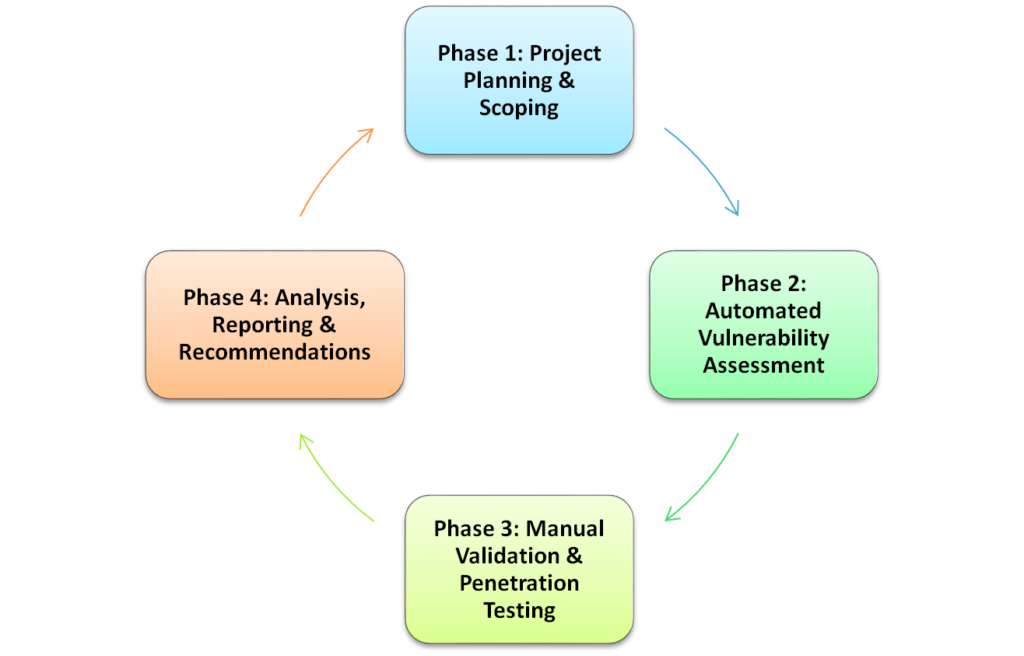
Phase 1 – Project Planning & Scoping
During phase 1, we established the engagement scope, objectives, and rules of engagement to ensure all testing activities were conducted in a controlled, authorized, and business-aligned manner. We worked with designated stakeholders to confirm the internal network segments included in scope, define testing constraints, agree on acceptable testing techniques, and establish communication procedures to minimize operational risk during the assessment.
Key Activities
- Scope and Objectives Definition
- Identified internal network ranges, VLANs, and segments in scope.
- Identified critical systems, applications, and business services to prioritize.
- Defined assessment objectives, including exposure identification and attack path validation.
- Confirmed exclusions such as sensitive systems or production constraints.
- Rules of Engagement (RoE) Agreement
- Defined acceptable testing techniques and limitations.
- Confirmed whether denial-of-service and destructive testing are excluded.
- Established testing windows, escalation procedures, and incident handling protocols.
- Agreed on evidence collection and data handling requirements.
- Engagement Coordination
- Identified technical and business points of contact.
- Confirmed assessment timeline and milestones.
- Validated reporting format and delivery expectations.
- Conducted a formal kick-off meeting to confirm readiness.
Phase 2 – Automated Vulnerability Assessment
In phase 2 of this engagement, we performed automated discovery and vulnerability assessment activities across the scoped internal network ranges to identify live hosts, exposed services, operating systems, and known vulnerabilities. This enabled us to build an accurate inventory of reachable systems and identify potential attack surfaces requiring deeper manual validation.
- Host Discovery
- Performed ICMP-based discovery to identify live hosts.
- Used TCP and UDP probes to identify systems that do not respond to ICMP.
- Recorded all responsive IP addresses as valid targets for further assessment.
- Established an authoritative list of internal hosts.
- Service Enumeration
- Conducted comprehensive TCP and UDP port scanning on discovered hosts.
- Identified listening services and exposed interfaces.
- Enumerated common infrastructure, management, and application services.
- Captured service banners and response data for analysis.
- Operating System Identification
- Analysed network responses and protocol behaviour to infer operating systems.
- Evaluated service banners from protocols such as HTTP, FTP, SMTP, and SMB.
- Correlated OS detection results with identified services.
- Validated findings to improve accuracy and reduce misclassification.
- Vulnerability Identification
- Tested identified services and platforms against a curated vulnerability library.
- Identified missing patches, insecure configurations, and known weaknesses.
- Executed only non-intrusive vulnerability checks to avoid service disruption.
- Recorded vulnerability details including affected systems and evidence.
Phase 3 – Manual Validation & Penetration Testing
For phase 3, we conducted targeted manual penetration testing to validate the exploitability of selected vulnerabilities and assess the practical impact of a potential compromise. We simulated realistic attacker techniques to obtain initial access, attempt privilege escalation, and evaluate opportunities for lateral movement toward critical assets within the internal environment.
The activities below reflect the testing patterns performed.
- Manual Verification of Vulnerabilities
- Validated high and medium risk findings identified during automated scanning.
- Eliminated false positives through manual inspection and controlled testing.
- Reviewed service configurations, banners, and responses where exploitation is unsafe.
- Confirmed exploitability assumptions based on environment-specific conditions.
- Initial Access and Exploitation
- Attempted exploitation of validated vulnerabilities using safe techniques.
- Targeted exposed services, weak authentication mechanisms, and misconfigurations.
- Established controlled access to compromised systems where permitted.
- Documented successful exploitation with detailed evidence.
- Privilege Escalation
- Attempted to escalate privileges on compromised systems.
- Identified weak permissions, vulnerable services, and credential exposure.
- Validated the potential for administrative or root-level access.
- Assessed impact on system integrity and security boundaries.
- Lateral Movement and Attack Path Analysis
- Enumerated compromised systems for credentials, trusts, and network access.
- Attempted lateral movement to additional internal systems.
- Identified paths to critical assets such as databases, domain controllers, or application servers.
- Demonstrated potential blast radius of an internal compromise.
Tools Used
- Enterprise Vulnerability Management (VAM) – Used to perform automated internal host discovery, service enumeration, operating system identification, and non-intrusive vulnerability detection across scoped internal network ranges.
- Nmap – Used to supplement automated discovery with targeted TCP and UDP port scanning, service validation, and operating system fingerprinting where additional verification was required.
- Metasploit Framework – Used to validate exploitability of confirmed vulnerabilities through controlled exploitation techniques and to develop proof-of-concept demonstrations where permitted.
- Impacket Toolkit – Used for credential-based attacks, authentication testing, lateral movement validation, and interaction with Windows network protocols during internal testing.
- CrackMapExec – Used to assess credential reuse, privilege levels, and access paths across Windows environments during lateral movement and privilege escalation testing.
- PowerShell (Native Windows Utilities) – Used for local system enumeration, privilege escalation checks, and validation of misconfigurations on compromised Windows hosts.
- Linux Native Enumeration Tools (e.g., sudo, netstat, ip, ps) – Used to validate privilege escalation paths, service exposure, and system configuration weaknesses on Linux-based internal assets where applicable.
Phase 4 – Analysis, Reporting & Recommendations
During the final phase, we consolidated automated and manual testing results, assessed risk severity based on ease of exploitation and impact, and prepared a comprehensive internal penetration testing report. We documented confirmed vulnerabilities, demonstrated attack paths, and provided prioritized remediation recommendations designed to strengthen the organization’s internal security posture.
- Findings Analysis and Risk Assessment
- Consolidated automated and manual testing results.
- Assessed risk based on ease of exploitation, impact, and exposure.
- Identified recurring themes and systemic weaknesses.
- Highlighted successful attack paths and critical security gaps.
- Reporting and Documentation
- Prepared the final penetration testing report including:
- Executive Summary
- Scope and Methodology
- Detailed Findings with Evidence
- Attack Scenarios and Impact Analysis
- Risk Ratings and Observations
- Ensured findings are clearly traceable to tested systems.
- Recommendations and Improvement Guidance
- Provided actionable remediation recommendations.
- Aligned recommendations with CIS Controls, OWASP Top 10, and MITRE ATT&CK.
- Suggested prioritization based on risk and business impact.
- Supported integration of findings into ongoing security programs.
Report
At the conclusion of the engagement, Real Secure IT delivered a comprehensive Internal Penetration Testing report that documented the results of the assessment in a clear, structured, and actionable manner. The report was developed to support both technical teams and executive stakeholders, providing a consistent view of the organization’s internal security posture and areas requiring attention.
The most crucial section of the report was the detailed risk register. Identified vulnerabilities and weaknesses were documented in a tabular format capturing key information such as the affected system or service, vulnerability description, assigned risk rating, and supporting evidence. In parallel, summary charts were used to illustrate the overall distribution of findings by severity, enabling stakeholders to quickly understand the risk landscape and identify priority areas.
Each identified issue was assessed based on its likelihood of exploitation and potential business impact, resulting in an assigned risk level. This risk-based presentation allowed findings to be reviewed collectively across the environment while preserving the detail required for technical remediation.
In addition to identifying weaknesses, the report also highlighted areas where existing controls and configurations were effective. Notable strengths observed during the assessment were documented to provide balanced visibility into the organization’s security posture and to acknowledge practices that contribute positively to risk reduction and operational stability.
Executive-level summaries were included to support informed decision-making by leadership. These sections provided a high-level overview of overall risk exposure, emphasized high-risk findings requiring immediate attention, and summarized key observations across the internal environment without requiring detailed technical interpretation.
Recommendations were explicitly tied to identified risks and were presented in a practical, actionable manner, ensuring the report served not only as an assessment record but also as a usable guide for strengthening the organization’s internal IT risk posture through targeted, achievable improvements.
Assessment Findings
The internal security assessment identified a significant number of security risks across the organization’s internal IT environment, spanning user-facing systems, server infrastructure, and internally accessible applications. The assessment combined vulnerability assessment activities and targeted penetration testing, with findings documented and analysed in a structured manner to provide clear visibility into technical weaknesses and control gaps.
In total, the assessment documented 110 findings, reflecting a mix of high, medium, and low risk issues that collectively impact the organization’s security posture.
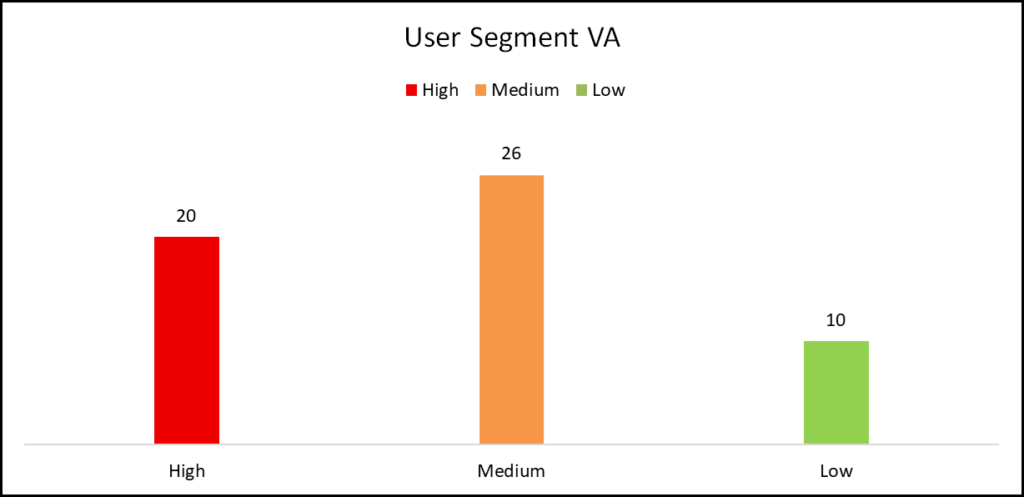
The vulnerability assessment of the user segment identified 56 risks, comprising 20 high-risk, 26 medium-risk, and 10 low-risk findings. This phase focused on identifying weaknesses affecting users, access controls, governance practices, and operational processes. High-risk issues in this segment were primarily related to access governance, privilege management, business continuity planning, security awareness, and personnel-related controls. These weaknesses increase the likelihood of unauthorized access, insider misuse, and delayed or ineffective response during security incidents. Medium- and low-risk findings further highlight inconsistencies in control enforcement and monitoring, contributing to elevated residual risk if not addressed.
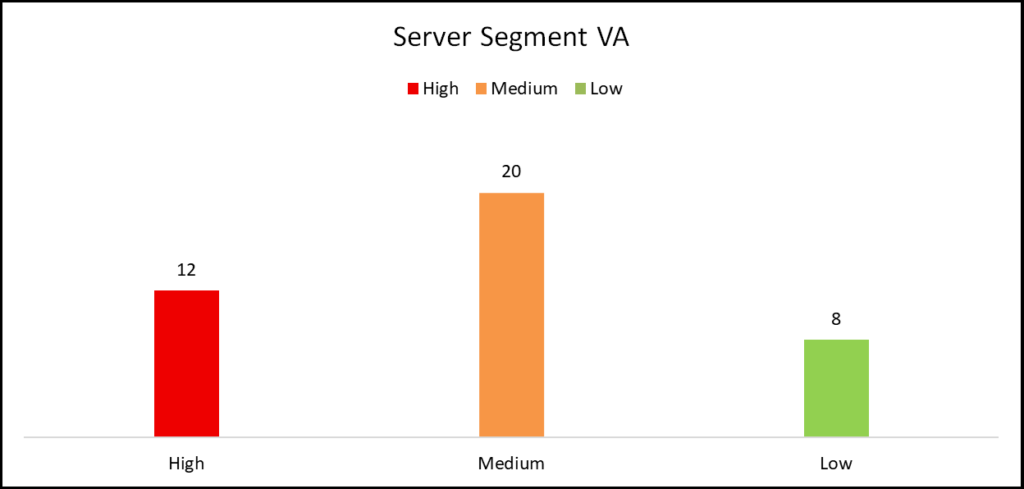
The vulnerability assessment of the server segment covered approximately 200 internal IP addresses and identified 40 risks, including 12 high-risk, 20 medium-risk, and 8 low-risk findings. The findings were driven by outdated or unsupported software, insecure service configurations, weak cryptographic settings, and legacy protocols enabled within the internal network. Several high-risk vulnerabilities expose systems to well-known and actively exploited attack techniques, increasing the likelihood of system compromise, lateral movement, and operational disruption in the event of an internal breach.
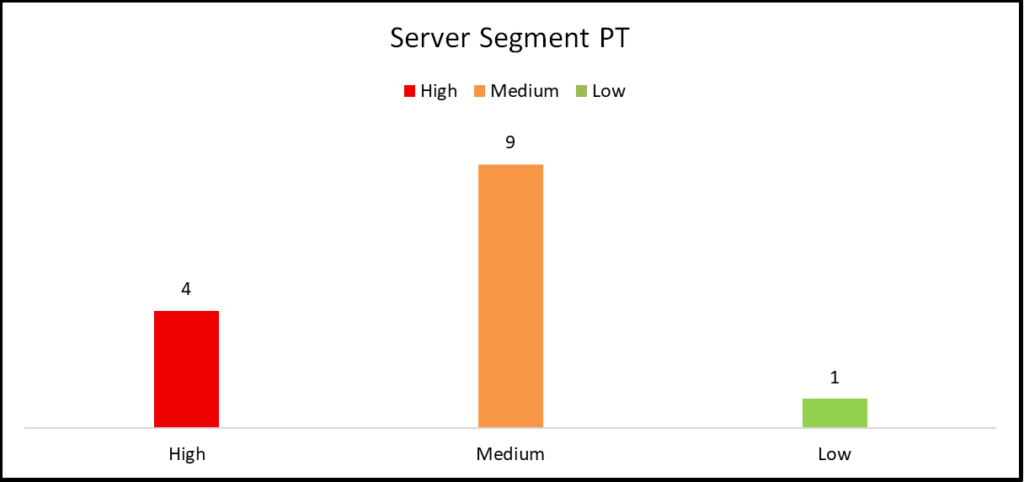
In addition, penetration testing conducted on the server segment, also covering 200 internal IP addresses, identified 14 findings, consisting of 4 high-risk, 9 medium-risk, and 1 low-risk issue. This phase simulated real-world attack scenarios to validate the exploitability of identified weaknesses. The testing demonstrated how an attacker with internal network access could bypass authentication controls, access sensitive file shares, extract hardcoded credentials, and gain elevated access to backend systems. These results confirm that several vulnerabilities represent immediate and practical risk rather than theoretical exposure.
Overall, the findings show that security risk is distributed across people, processes, and technology rather than isolated to individual systems. High-risk issues present immediate exposure, while the accumulation of medium- and low-risk weaknesses increases the likelihood of successful attacks when combined. The assessment provided a clear foundation for prioritizing remediation efforts and strengthening internal security controls to reduce attack surface and improve resilience against internal threat scenarios.
Section 1: Vulnerability Assessment – User Segment
High-Risk Findings
- Outdated Apache HTTP Server Exposed to Multiple Critical Vulnerabilities (Risk: High)
The assessment identified that the web server is running Apache HTTP Server version 2.4 and is actively disclosing its version information through HTTP response headers. This version of Apache is associated with a wide range of publicly disclosed vulnerabilities affecting both the core server engine and commonly enabled modules. Several of these vulnerabilities stem from improper input validation, unsafe memory handling, and flawed request parsing logic.
In particular, vulnerable modules such as mod_lua, mod_macro, mod_proxy, and mod_http2 introduce additional attack vectors that can be abused by an attacker with network access to the service. Exploitable conditions include malformed HTTP/2 requests, crafted proxy headers, and specially structured requests that can trigger buffer overflows or out-of-bounds memory access. These weaknesses may allow an attacker to manipulate server responses, bypass authentication controls, execute arbitrary code, or crash the service.
Because this web server is accessible within the internal environment, exploitation does not require internet exposure. An attacker who has gained a foothold internally—through phishing, compromised credentials, or another vulnerable host—could leverage these Apache vulnerabilities to escalate privileges, pivot further into the network, or disrupt critical business services.
Cause:
- Apache HTTP Server has not been upgraded to address known security vulnerabilities.
- Default and potentially unnecessary modules remain enabled.
- Server configuration exposes version and banner information, aiding targeted attacks.
Consequences and security implications:
- Remote Code Execution: Attackers could execute arbitrary commands on the server by exploiting vulnerable modules.
- Unauthorized Access: Authentication bypass or session manipulation could allow access to protected applications.
- Service Disruption: Exploitation could crash the web service or exhaust system memory, leading to denial of service.
- Lateral Movement: A compromised web server may be used as a pivot point to access backend systems or databases.
Existing controls:
- Basic network-level access controls restrict external exposure.
- Web server activity is logged for operational purposes.
Gaps:
- No regular patching or version review process for web server software.
- Lack of hardening to disable unused Apache modules.
- Absence of compensating controls to mitigate known Apache attack techniques.
Recommended remediation strategy:
- Upgrade Apache HTTP Server: Upgrade the Apache HTTP Server to the latest stable and vendor-supported version to remediate all known vulnerabilities listed in the assessment, including memory corruption, request smuggling, and HTTP/2 handling flaws.
- Module Hardening: Perform a detailed review of all enabled Apache modules and explicitly disable non-essential modules such as mod_lua, mod_macro, mod_proxy, and mod_http2 if they are not required for business operations, thereby reducing the attack surface.
- Configuration Hardening: Update Apache configuration files to suppress server version disclosure in HTTP headers and error pages using directives such as ServerTokens Prod and ServerSignature Off.
- Protocol and Request Handling Controls: Enforce strict request size limits, header validation, and timeout configurations to reduce the risk of malformed request exploitation and denial-of-service attacks.
- Ongoing Maintenance: Integrate the Apache service into the organization’s regular patch management and vulnerability scanning cycle to ensure newly disclosed vulnerabilities are identified and remediated in a timely manner.
Impact of remediation:
- Eliminates exposure to known remote code execution and denial-of-service vulnerabilities.
- Reduces the internal attack surface available to compromised users or hosts.
- Improves service stability and aligns web infrastructure with secure configuration best practices.
- Microsoft Message Queuing (MSMQ) Remote Code Execution (Risk: High)
The assessment revealed that the Microsoft Message Queuing (MSMQ) service running on the affected host is vulnerable to a remote code execution flaw. This vulnerability allows an unauthenticated attacker to send specially crafted messages to the MSMQ service, resulting in arbitrary code execution without requiring valid credentials or user interaction.
MSMQ is often used for asynchronous communication between applications and typically runs with elevated system privileges. As a result, successful exploitation would grant the attacker a high level of access to the underlying operating system. In an internal network context, this vulnerability is particularly dangerous, as attackers commonly scan for messaging services once initial access is obtained.
Exploitation of this flaw could allow attackers to install malware, manipulate application workflows, or establish persistent access to the system. Given MSMQ’s role in application communication, compromise of this service could also disrupt dependent business processes.
Cause:
- MSMQ service has not been updated with vendor-released security patches.
- The service is accessible within the internal network without restrictive filtering.
Consequences and security implications:
- Arbitrary Code Execution: Attackers can execute malicious code with elevated privileges.
- Persistent Compromise: The system may be used to deploy backdoors or malware.
- Operational Disruption: Manipulation of message queues could disrupt business applications.
- Lateral Movement: Compromised hosts may be leveraged to attack other internal systems.
Existing controls:
- MSMQ operates behind internal network boundaries.
- Basic system logging is enabled.
Gaps:
- No patching controls to ensure messaging services remain secure.
- Lack of access restrictions limiting who can interact with MSMQ.
Recommended remediation strategy:
- Apply Vendor Security Updates: Install all Microsoft-released security patches addressing the MSMQ remote code execution vulnerability in accordance with official vendor advisories.
- Service Exposure Review: Assess whether MSMQ is required on the affected host. If the service is not essential to business operations, disable or remove it entirely to eliminate the attack vector.
- Network Access Restrictions: Restrict MSMQ access at the network level by allowing communication only from trusted systems that explicitly require messaging functionality.
- Service Monitoring: Enable logging and monitoring for MSMQ-related events to detect abnormal message patterns that may indicate attempted exploitation.
Impact of remediation:
- Removes a high-impact remote code execution vector.
- Reduces the risk of system-level compromise from internal attackers.
- Strengthens the security of application messaging infrastructure.
- BlueKeep and MS12-020 Vulnerabilities in Remote Desktop Protocol (Risk: High)
The assessment confirmed that the affected systems are vulnerable to critical Remote Desktop Protocol (RDP) flaws, including BlueKeep and MS12-020. These vulnerabilities arise from improper handling of memory objects within the RDP service and allow unauthenticated attackers to execute arbitrary code by sending specially crafted RDP requests.
BlueKeep is particularly severe due to its wormable nature, meaning an attacker does not need valid credentials or user interaction to exploit the flaw. Once a system is compromised, malware can automatically propagate to other vulnerable RDP-enabled systems within the internal network. In environments where RDP is widely enabled for administration or support, this presents a substantial risk of rapid, network-wide compromise.
Cause:
- Systems are running outdated Windows versions or missing critical security patches.
- RDP services are enabled without adequate access restrictions.
Consequences and security implications:
- Full System Takeover: Attackers can gain complete control over affected systems.
- Rapid Malware Spread: Wormable exploitation can lead to widespread outages.
- Data Compromise: Attackers can access, modify, or destroy sensitive information.
- Operational Impact: Critical services may be disrupted or rendered unavailable.
Existing controls:
- Internal firewall rules restrict some external access.
Gaps:
- RDP services lack up-to-date security patches.
- No additional safeguards such as Network Level Authentication are enforced consistently.
Recommended remediation strategy:
- Apply Microsoft Security Patches: Immediately apply all Microsoft security updates released for BlueKeep and MS12-020 vulnerabilities across all affected Windows systems, including legacy platforms where extended patches are available.
- Harden RDP Configuration: Enable Network Level Authentication (NLA) on all systems where RDP is required to ensure authentication occurs before session establishment.
- Restrict RDP Access: Limit RDP access to authorized administrative users and trusted internal network segments only, reducing exposure to unauthorized access attempts.
- Service Reduction: Disable RDP on systems where remote desktop functionality is not required for operational or administrative purposes.
Impact of remediation:
- Prevents catastrophic, wormable exploitation scenarios.
- Reduces internal attack propagation risks.
- Secures a commonly abused remote access service.
- Unsupported Microsoft SQL Server (Risk: High)
The assessment identified that the Microsoft SQL Server instance running on the affected host has reached end-of-life and is no longer supported by the vendor. Unsupported SQL Server versions do not receive security updates, leaving known vulnerabilities permanently unpatched. SQL Server typically stores highly sensitive business data and often runs with elevated privileges.
Exploitation of unpatched vulnerabilities could allow attackers to gain unauthorized access to databases, execute commands on the underlying system, or compromise applications that depend on the database. In an internal threat scenario, attackers frequently target outdated database servers to escalate access or extract sensitive information.
Cause:
- SQL Server has not been upgraded in line with Microsoft’s support lifecycle.
- Absence of enforced patch management for database infrastructure.
Consequences and security implications:
- Data Breach Risk: Sensitive business and operational data may be exposed.
- System Compromise: Database vulnerabilities can be leveraged for OS-level attacks.
- Regulatory Impact: Use of unsupported software may violate compliance requirements.
Existing controls:
- Network controls restrict access to database ports.
Gaps:
- No roadmap to migrate unsupported database platforms.
- Lack of compensating controls for end-of-life systems.
Recommended remediation strategy:
- Upgrade to Supported Version: Upgrade the existing Microsoft SQL Server installation to a currently supported version that continues to receive security patches and vendor support.
- Compatibility Validation: Prior to upgrade, validate application compatibility and database schema integrity to ensure business continuity and minimize operational impact.
- Access Control Review: Review and restrict SQL Server access to only authorized applications and administrative accounts to reduce exposure during and after migration.
- Ongoing Patch Management: Enroll the upgraded SQL Server instance into the organization’s patch management and vulnerability assessment processes to ensure continued security.
Impact of remediation:
- Reduces likelihood of database compromise or data loss.
- Improves long-term maintainability and security of critical data stores.
- Aligns database infrastructure with vendor-supported security standards.
- SMBv1 Enabled on Windows Host (Risk: High)
The assessment identified that Server Message Block version 1 (SMBv1) is enabled on the affected Windows host. SMBv1 is a deprecated file-sharing protocol that lacks modern security features such as encryption and secure authentication. Multiple critical vulnerabilities affecting SMBv1 allow unauthenticated remote attackers to execute arbitrary code by sending specially crafted SMB requests.
These vulnerabilities have been exploited in widespread attacks such as WannaCry and NotPetya. In an internal environment, an attacker who gains access to a single vulnerable host can exploit SMBv1 to rapidly propagate malware, enumerate network shares, and compromise additional systems without user interaction.
Cause:
- Legacy protocol remains enabled due to misconfiguration or backward compatibility requirements.
- Systems have not been hardened to disable insecure services.
Consequences and security implications:
- Remote Code Execution: Attackers can fully compromise systems without authentication.
- Malware Propagation: SMBv1 facilitates rapid lateral spread across internal networks.
- Information Disclosure: Attackers may enumerate users, shares, and sensitive files.
Existing controls:
- Network segmentation limits some exposure.
Gaps:
- SMBv1 remains enabled despite availability of secure alternatives.
- No monitoring in place to detect SMB exploitation attempts.
Recommended remediation strategy:
- Disable SMBv1 Protocol: Disable SMBv1 on all affected Windows hosts through system configuration or Group Policy, as the protocol is deprecated and no longer required for modern Windows environments.
- Migrate to Secure Protocols: Ensure all file-sharing and network communication services use SMBv2 or SMBv3, which provide improved security and resilience against known attack techniques.
- Dependency Identification: Identify and remediate any legacy systems or applications that rely on SMBv1, updating or replacing them where necessary.
- Traffic Monitoring: Monitor SMB traffic for unusual patterns that may indicate exploitation attempts or unauthorized lateral movement.
Impact of remediation:
- Eliminates a high-risk and widely exploited attack vector.
- Reduces the risk of ransomware and lateral movement.
- Strengthens internal network resilience against internal threats.
- Unsupported Microsoft Windows XP Operating System (Risk: High)
The assessment identified a remote host running Microsoft Windows XP, an operating system that has reached end-of-life and is no longer supported by Microsoft. As official support has ended, Windows XP no longer receives security patches, vulnerability fixes, or technical support. Any newly discovered vulnerabilities affecting this operating system remain permanently unpatched, regardless of severity.
Windows XP lacks modern security controls such as enhanced memory protections, secure boot mechanisms, and hardened authentication models found in newer Windows versions. As a result, systems running Windows XP are significantly more susceptible to exploitation techniques such as remote code execution, privilege escalation, malware infection, and ransomware deployment. Attackers actively target unsupported systems because they represent low-effort, high-reward entry points into internal environments.
Once compromised, a Windows XP host can be leveraged as a foothold for lateral movement, credential harvesting, or command-and-control communication within the internal network. The presence of unsupported operating systems also increases the likelihood of compliance violations and operational risk.
Cause:
- The continued use of legacy systems that have exceeded their vendor-supported lifecycle.
- Business or application dependencies preventing timely operating system upgrades.
- Absence of enforced asset lifecycle and decommissioning policies.
Consequences and security implications:
- Unpatchable Vulnerabilities: Any newly discovered flaws remain exploitable indefinitely.
- Increased Malware Risk: Legacy systems are frequently targeted by exploit kits and malware campaigns.
- Lateral Movement: Compromised XP systems can be used to pivot deeper into the internal network.
- Compliance Exposure: Use of unsupported software may violate internal security policies or regulatory expectations.
Existing controls:
- None identified that effectively mitigate the inherent risks of an unsupported operating system.
Gaps:
- No compensating controls sufficient to offset the lack of vendor security updates.
- Lack of isolation or segmentation to limit impact if compromised.
Recommended remediation strategy:
- Operating System Upgrade: Replace Windows XP with a currently supported Microsoft Windows operating system that receives regular security updates.
- Application Compatibility Review: Identify any legacy applications dependent on Windows XP and migrate them to supported platforms or modern equivalents.
- Asset Decommissioning: If the system is no longer required, securely decommission it to eliminate unnecessary exposure.
- Interim Risk Reduction (If Upgrade Delayed): Isolate the system on a restricted network segment, limit inbound and outbound connectivity, and monitor activity closely until full remediation is completed.
Impact of remediation:
- Eliminates exposure to unpatchable vulnerabilities.
- Reduces likelihood of system compromise and lateral movement.
- Improves overall security posture and compliance alignment.
- Apple Filing Protocol (AFP) Remote Code Execution Vulnerability (Risk: High)
The assessment revealed that the remote host is running an Apple Filing Protocol (AFP) service vulnerable to a remote code execution flaw caused by a buffer overflow during the processing of an Open Session request. This vulnerability allows an attacker to send specially crafted network traffic that triggers memory corruption, potentially resulting in arbitrary code execution on the target system.
Because AFP operates at the file-sharing layer, successful exploitation may grant attackers direct access to sensitive files, system resources, or user data. Depending on the privileges under which the service runs, attackers could gain elevated access and execute malicious payloads on the affected host.
This vulnerability is particularly dangerous in internal environments, where AFP services may be implicitly trusted and less closely monitored. Exploitation could lead to data theft, unauthorized file manipulation, or system compromise.
Cause:
- Outdated AFP implementation vulnerable to known buffer overflow conditions.
- Failure to apply vendor-released security updates.
- Unrestricted exposure of AFP services within the internal network.
Consequences and security implications:
- Remote Code Execution: Attackers may execute arbitrary code on the affected host.
- Data Exposure: File shares may be accessed, modified, or deleted without authorization.
- Lateral Movement: Compromised systems may be used to move deeper into the network.
- Service Disruption: Exploitation may crash the AFP service or destabilize the host.
Existing controls:
- None identified that sufficiently mitigate the vulnerability.
Gaps:
- Outdated AFP service remains exposed.
- No restriction on which systems can connect to the AFP service.
Recommended remediation strategy:
- Upgrade Netatalk: Upgrade the AFP implementation to Netatalk version 3.1.12 or later, which addresses the identified vulnerability.
- Service Necessity Review: Confirm whether AFP is still required. If not essential, disable the service entirely.
- Access Restrictions: Limit AFP access to only authorized hosts and users through firewall rules or network segmentation.
- Ongoing Monitoring: Monitor AFP service logs for abnormal connection attempts or exploitation indicators.
Impact of remediation:
- Removes a critical remote code execution vector.
- Protects file-sharing infrastructure from unauthorized access.
- Reduces risk of internal compromise and data loss.
- Outdated and Vulnerable OpenSSH Versions (Risk: High)
The assessment identified multiple hosts running outdated and unsupported OpenSSH versions affected by a wide range of critical vulnerabilities. These vulnerabilities span authentication bypasses, privilege escalation, arbitrary file read/write, command injection, denial-of-service, and remote code execution conditions.
Notably, the findings include vulnerabilities that allow attackers to bypass authentication limits, escalate privileges locally, manipulate files during SCP transfers, exploit protocol weaknesses such as the Terrapin attack, and in some versions, achieve root-level code execution due to race conditions in the SSH daemon.
OpenSSH is a core administrative service. Compromise of SSH directly undermines system integrity, confidentiality, and availability. An attacker who exploits these flaws may gain persistent access, deploy malware, harvest credentials, or use the compromised system as a staging point for further attacks.
Cause:
- Failure to keep OpenSSH software up to date.
- Lack of centralized patch management for critical infrastructure services.
- Continued use of unsupported or legacy SSH configurations.
Consequences and security implications:
- Unauthorized Access: Attackers may bypass authentication controls or brute-force access.
- Privilege Escalation: Local users may gain root or administrative privileges.
- Data Compromise: Arbitrary file access or manipulation through SCP vulnerabilities.
- Persistent Threats: Attackers can establish long-term access using SSH backdoors.
Existing controls:
- Basic SSH authentication mechanisms in place.
Gaps:
- No protection against known OpenSSH vulnerabilities.
- Lack of enforcement of modern, secure SSH versions.
Recommended remediation strategy:
- Upgrade OpenSSH: Upgrade all affected systems to OpenSSH version 10.0 or later, ensuring all known vulnerabilities are patched.
- Configuration Hardening: Disable insecure features such as X11 forwarding if not required, and enforce strong authentication settings.
- Key and Access Review: Review authorized SSH keys and remove obsolete or unused credentials.
- Patch Management Integration: Include OpenSSH in routine vulnerability scanning and patch cycles.
Impact of remediation:
- Eliminates multiple critical attack vectors.
- Secures administrative access channels.
- Reduces risk of system takeover and persistence.
- Unsupported Python Runtime Versions (Risk: High)
The assessment identified that one or more hosts are running unsupported versions of the Python programming language. Unsupported Python versions no longer receive security patches, bug fixes, or vulnerability remediation from the Python Software Foundation.
Python is often deeply integrated into system automation, web applications, and backend services. Vulnerabilities in the runtime environment can be exploited to compromise applications, bypass security controls, or execute arbitrary code. The risk is amplified when Python services are exposed over the network or used in privileged contexts.
Cause:
- Legacy application dependencies tied to outdated Python versions.
- Lack of runtime lifecycle management and version enforcement.
- Failure to update underlying development frameworks.
Consequences and security implications:
- Unpatched Vulnerabilities: Known and future Python flaws remain exploitable.
- Application Compromise: Attackers may exploit runtime weaknesses to execute malicious code.
- Supply Chain Risk: Vulnerable libraries may introduce additional attack vectors.
Existing controls:
- None identified to mitigate unsupported runtime risks.
Gaps:
- No enforced Python version standards.
- No automated updates or runtime validation.
Recommended remediation strategy:
- Upgrade Python Runtime: Migrate all systems and applications to a currently supported Python version that continues to receive security updates. This ensures that known vulnerabilities are patched and future security fixes remain available.
- Dependency and Compatibility Review: Review all applications, scripts, and third-party libraries that rely on Python to ensure compatibility with the supported version. Update or replace incompatible components as required to prevent service disruption.
- Standardize Python Usage Across the Environment: Define and enforce approved Python versions through configuration management or deployment standards to prevent unsupported runtimes from being reintroduced.
- Ongoing Version Monitoring: Periodically review Python versions in use across systems to ensure continued support and timely upgrades when versions approach end-of-life.
Impact of remediation:
- Reduces exposure to runtime-level vulnerabilities.
- Improves application security and maintainability.
- SSL 2.0 and SSL 3.0 Enabled on Remote Service (Risk: High)
The assessment identified that the remote service supports SSL 2.0 and/or SSL 3.0, both of which are obsolete cryptographic protocols with well-documented weaknesses. These protocols are vulnerable to downgrade attacks, padding oracle attacks (such as POODLE), and man-in-the-middle exploitation.
Even if stronger protocols are available, the presence of SSL 2.0 or SSL 3.0 allows attackers to force insecure protocol negotiation, enabling interception or decryption of sensitive communications. This places authentication credentials, session data, and confidential information at risk.
Cause:
- Legacy protocol support left enabled for backward compatibility.
- Inadequate cryptographic hardening of services.
Consequences and security implications:
- Encrypted Traffic Compromise: Attackers may decrypt or manipulate traffic.
- Credential Exposure: Authentication data may be intercepted.
- Compliance Failures: Use of obsolete protocols violates modern security standards.
Existing controls:
- None sufficient to mitigate protocol downgrade risks.
Gaps:
- Outdated SSL protocols remain enabled.
- No enforcement of modern TLS standards.
Recommended remediation strategy:
- Disable SSL 2.0 and SSL 3.0 Completely: Update the affected service and server configurations to fully disable SSL 2.0 and SSL 3.0, ensuring that these protocols cannot be negotiated under any circumstances.
- Enforce Secure TLS Protocols: Configure services to support only TLS 1.2 or higher, and restrict cipher suites to strong, modern cryptographic algorithms in line with current security best practices.
- Validate Configuration Changes: After making configuration updates, perform validation testing to confirm that insecure protocols are no longer accepted and that secure protocol negotiation functions as expected.
- Document and Monitor Cryptographic Standards: Document approved cryptographic settings and periodically review service configurations to prevent legacy protocols from being re-enabled over time.
Impact of remediation:
- Protects encrypted communications from interception.
- Aligns cryptographic controls with modern security standards.
- Reduces overall attack surface.
- Obsolete and Unsupported Web Server Software (Risk: High)
The assessment identified that the remote host is running a web server version that is obsolete and no longer maintained by the vendor. End-of-life web server software does not receive security patches, bug fixes, or performance improvements, leaving known vulnerabilities permanently unaddressed. As new attack techniques continue to emerge, unsupported software becomes increasingly vulnerable over time.
An attacker targeting this system would be able to exploit publicly documented vulnerabilities with a high likelihood of success, potentially gaining unauthorized access, executing arbitrary code, or disrupting web services. The continued operation of obsolete web server software also increases the organization’s exposure to automated attacks, as outdated platforms are frequently targeted by scanning tools and exploit kits.
If the affected web server is internet-facing or accessible internally by a compromised user account, it could serve as an entry point for lateral movement or data exfiltration within the internal network.
Cause:
- Continued use of legacy web server software beyond vendor support timelines.
- Lack of enforced lifecycle management for web-facing and internal services.
- Insufficient visibility into software versioning across deployed systems.
Consequences and security implications:
- Remote Exploitation Risk: Known vulnerabilities can be exploited without the possibility of vendor patches.
- Unauthorized Access: Attackers may gain access to sensitive data or internal systems.
- Operational Instability: Unsupported software is more prone to crashes or service degradation.
- Compliance Exposure: Running unsupported software may violate internal security policies or regulatory requirements.
Existing controls:
- Basic system monitoring is in place.
- Some systems undergo periodic patching.
Gaps:
- No enforced policy preventing unsupported software from remaining in production.
- Lack of automated alerts for end-of-life software versions.
- Inconsistent upgrade and decommissioning processes.
Recommended remediation strategy:
- Remove Unused Web Servers: If the service is no longer required, fully decommission and remove it to eliminate unnecessary attack surface.
- Upgrade to a Supported Version: If required for business operations, migrate to a currently supported web server version that receives regular security updates.
- Establish Software Lifecycle Management: Define and enforce policies that require upgrades or removal before software reaches end-of-support.
- Maintain an Inventory of Web Services: Track deployed web servers and their versions to ensure visibility and timely remediation.
Impact of remediation:
- Reduces exposure to known and unpatchable vulnerabilities.
- Improves overall service stability and security posture.
- Ensures continued vendor support and security updates.
- Limits opportunities for attackers to exploit legacy services.
- Unsupported or Unpatched Windows Operating System (Risk: High)
The assessment revealed that the remote Windows host is running an operating system that is either missing the latest service pack or has reached end-of-support. Systems in this state no longer receive critical security updates from Microsoft, leaving them exposed to both known and newly discovered vulnerabilities.
Attackers actively target outdated Windows systems due to the availability of reliable exploits. Once compromised, such systems can be used to escalate privileges, access sensitive data, or serve as pivot points for attacks against other internal resources. The lack of regular security updates significantly weakens the system’s ability to defend against modern threats.
Cause:
- Failure to apply required service packs or security updates.
- Continued reliance on legacy operating systems.
- Inadequate patch management and compliance enforcement.
Consequences and security implications:
- Increased Exploitability: Public exploits remain effective indefinitely.
- System Compromise: Attackers may gain administrative access.
- Lateral Movement Risk: Compromised systems can be used to attack other hosts.
- Compliance Risk: Unsupported operating systems may breach security and regulatory requirements.
Existing controls:
- Some patch management activities exist.
- SOC monitoring may detect anomalous behavior.
Gaps:
- Patch compliance is not enforced consistently.
- Legacy systems remain operational without risk acceptance or mitigation.
- No formal process for decommissioning unsupported operating systems.
Recommended remediation strategy:
- Upgrade to a Supported Windows Version: Migrate affected systems to a fully supported operating system.
- Apply Latest Service Packs: Ensure all supported systems are fully patched.
- Implement Patch Compliance Monitoring: Regularly verify patch levels across all Windows hosts.
- Isolate Legacy Systems if Necessary: If immediate upgrade is not possible, restrict network access as a temporary mitigation.
Impact of remediation:
- Restores access to critical security updates.
- Reduces likelihood of successful exploitation.
- Improves system reliability and resilience.
- Strengthens compliance with security best practices.
- Critical Remote Desktop Protocol (RDP) Memory Handling Vulnerability (Risk: High)
The assessment identified a critical vulnerability in the Remote Desktop Protocol (RDP) implementation on the affected Windows host. The issue stems from improper handling of memory objects, specifically scenarios where objects are accessed after being incorrectly initialized or after they have already been deleted. This flaw creates an unsafe memory state that can be reliably exploited.
If RDP is enabled on the affected system, an unauthenticated remote attacker could exploit this vulnerability by sending specially crafted RDP requests, causing the system to execute arbitrary code. Exploitation does not require valid credentials or user interaction, which significantly increases the risk. In addition to remote code execution, a related denial-of-service condition may also be present, allowing attackers to crash or destabilize the system, potentially impacting the availability of critical services.
Given that RDP is commonly enabled for administrative access, exploitation of this vulnerability could provide attackers with a direct path to full system compromise and a strong foothold within the internal network.
Cause:
- Vulnerable RDP implementations are present on outdated or unpatched Windows operating systems.
- Missing Microsoft security patches addressing known memory handling flaws.
- RDP services enabled without sufficient restriction or hardening.
Consequences and security implications:
- Remote Code Execution: Attackers can gain full control of the affected system without authentication.
- Service Disruption: Successful exploitation may result in system crashes or instability.
- Lateral Movement: Compromised systems can be leveraged to attack other internal hosts.
- High Business Impact: Critical systems may become unavailable or compromised.
Existing controls:
- Some network-level restrictions may be in place.
- SOC monitoring exists for anomalous activity.
Gaps:
- Vulnerable systems remain unpatched.
- RDP exposure is not consistently minimized.
- Legacy systems rely on extended or expired support models.
Recommended remediation strategy:
- Apply Microsoft Security Patches: Install the relevant Microsoft patches for all affected Windows versions to remediate the underlying memory handling flaw.
- Restrict RDP Access: Limit RDP exposure to trusted internal networks or specific IP addresses to reduce the attack surface.
- Disable RDP Where Not Required: Fully disable RDP services on systems where remote access is not operationally necessary.
- Monitor RDP Activity: Enable detailed logging and continuously monitor RDP connections for suspicious or abnormal behavior.
Impact of remediation:
- Eliminates unauthenticated remote exploitation paths.
- Reduces exposure of critical systems to RDP-based attacks.
- Improves system stability and overall security posture.
- Schannel Remote Code Execution Vulnerability (Risk: High)
The assessment identified that the remote Windows host is vulnerable to a critical remote code execution flaw within the Schannel security package, which is responsible for handling SSL and TLS communications on Windows systems. This vulnerability exists due to improper processing of specially crafted network packets during encrypted communication.
A remote attacker could exploit this weakness by sending malicious packets to the affected service. If exploitation is successful, arbitrary code may be executed in the context of the affected service, potentially allowing the attacker to gain full control over the system. Because Schannel underpins encrypted communications, exploitation of this vulnerability represents a serious risk to both system integrity and the confidentiality of transmitted data.
Cause:
- Unpatched Windows systems running vulnerable Schannel implementations.
- SSL/TLS services exposed on affected hosts.
- Delays in applying Microsoft security updates.
Consequences and security implications:
- Full System Compromise: Attackers may execute arbitrary code remotely.
- Credential and Data Exposure: Sensitive information handled by SSL/TLS services may be accessed.
- Persistent Access: Compromised systems can be used to maintain long-term attacker presence.
- Network-Wide Risk: Exploited hosts may facilitate further internal attacks.
Existing controls:
- Network monitoring and logging capabilities.
- Partial patch management practices.
Gaps:
- Critical security patches not consistently applied across all systems.
- Encrypted services exposed on outdated operating systems.
Recommended remediation strategy:
- Apply Microsoft Security Updates: Install all Microsoft patches that address the Schannel vulnerability across affected Windows versions.
- Verify TLS Configuration: Ensure that only secure, supported TLS versions are enabled on affected systems.
- Reduce Service Exposure: Limit network access to affected services where possible until patching is complete.
- Monitor Encrypted Traffic: Monitor SSL/TLS traffic patterns to identify abnormal behavior that may indicate exploitation attempts.
Impact of remediation:
- Removes a critical remote code execution vector within encrypted services.
- Strengthens the security of SSL/TLS communications.
- Reduces the likelihood of system compromise through protocol-level attacks.
- SMBv1 Enabled – Multiple Remote Code Execution Vulnerabilities (Risk: High)
During the security assessment, it was identified that the remote Windows host has Server Message Block version 1.0 (SMBv1) enabled. SMBv1 is a deprecated and insecure file-sharing protocol that lacks modern security controls and protections. Its continued use exposes systems to several well-known, high-impact vulnerabilities.
Multiple remote code execution vulnerabilities were identified within SMBv1 (CVE-2017-0143 through CVE-2017-0146 and CVE-2017-0148). These flaws result from improper handling of specially crafted SMB requests. A remote, unauthenticated attacker can exploit these vulnerabilities to execute arbitrary code on the affected system without requiring valid credentials.
In addition, an information disclosure vulnerability (CVE-2017-0147) was identified, allowing attackers to retrieve sensitive information from the target system. Because SMB is commonly used for file sharing and internal communication, exploitation of these vulnerabilities can result in rapid system compromise and facilitate lateral movement across the internal network.
Cause:
- SMBv1 remains enabled on legacy or unpatched Windows systems.
- Lack of protocol hardening or deprecation enforcement.
- Systems relying on outdated configurations for compatibility purposes.
Consequences and security implications:
- Remote Code Execution: Attackers can fully compromise the affected system without authentication.
- Rapid Malware Propagation: SMBv1 vulnerabilities are commonly exploited by self-propagating malware.
- Information Disclosure: Sensitive system and user data may be exposed.
- Lateral Movement: Compromised hosts can be used to attack other internal systems.
Existing controls:
- Network segmentation may limit some exposure.
- General monitoring of network activity is in place.
Gaps:
- Deprecated SMBv1 protocol remains enabled.
- Systems are not uniformly configured to enforce modern SMB versions.
- Lack of proactive legacy protocol removal.
Recommended remediation strategy:
- Disable SMBv1: Fully disable SMBv1 on all Windows systems where it is enabled to eliminate exposure to known vulnerabilities.
- Upgrade SMB Protocols: Ensure systems use SMBv2 or SMBv3, which provide stronger security features and improved resilience.
- Apply Security Updates: Install all relevant Microsoft security patches to address SMB-related vulnerabilities.
- Validate Compatibility: Confirm that applications and services function correctly using newer SMB versions before permanent removal of SMBv1.
Impact of remediation:
- Eliminates a major remote code execution attack vector.
- Reduces the likelihood of ransomware and worm-based attacks.
- Improves overall internal network security and resilience.
- NTP monlist Function Enabled – Denial of Service Risk (Risk: High)
During the security assessment, it was identified that the Network Time Protocol daemon (ntpd) running on the remote host has the legacy monlist command enabled. This diagnostic feature returns a list of the most recent clients that have communicated with the NTP server. While originally intended for troubleshooting, the monlist functionality is inherently insecure and has been widely abused in large-scale attacks.
The implementation of this feature is vulnerable due to a flaw in the ntp_request.c component, which allows an unauthenticated remote attacker to exploit the service by sending a high volume of spoofed requests. This can cause the server to generate amplified responses, resulting in a denial-of-service (DoS) condition. In some cases, the affected system may become unresponsive or contribute to broader distributed denial-of-service (DDoS) attacks targeting other organizations.
Because NTP services are often trusted and widely accessible within internal networks, exploitation of this vulnerability can disrupt time synchronization, which is critical for authentication, logging, and incident correlation across systems.
Cause:
- Legacy monlist functionality enabled in ntpd configuration.
- Use of outdated NTP versions where monlist is enabled by default.
- Lack of configuration hardening for infrastructure services.
Consequences and security implications:
- Denial of Service: Attackers can overwhelm the NTP service, causing outages or degraded performance.
- Operational Disruption: Loss of accurate time synchronization can impact authentication, logging, and monitoring systems.
- Abuse in DDoS Attacks: The host may be leveraged as an amplifier in attacks against third parties.
- Reduced Visibility: Incorrect timestamps can hinder forensic investigations and incident response.
Existing controls:
- General network monitoring is in place.
- Infrastructure services are operationally managed.
Gaps:
- Insecure legacy NTP features remain enabled.
- No restrictions on who can query the NTP service.
- Configuration not aligned with modern security guidance.
Recommended remediation strategy:
- Upgrade NTP Service: Upgrade to NTP version 4.2.7p26 or later, where the monlist feature is disabled by default.
- Disable Monitoring Explicitly: Add disable monitor to the ntp.conf file and restart the ntpd service to prevent abuse.
- Restrict Access: Limit NTP access to trusted internal hosts where feasible.
- Validate Configuration: Confirm that monlist functionality is no longer accessible after changes are applied.
Impact of remediation:
- Eliminates a known DoS and amplification vector.
- Improves reliability of time synchronization services.
- Reduces the risk of infrastructure abuse and operational outages.
- SMB NULL Session Authentication Enabled (Risk: High)
During the assessment, it was identified that the remote host allows NULL session authentication over the Server Message Block (SMB) protocol. This configuration permits unauthenticated users to establish a session using a blank username and password. While access granted through NULL sessions may be limited, it can still expose sensitive information depending on system configuration.
An unauthenticated attacker can leverage this weakness to enumerate system details, shared resources, user accounts, and group memberships. This information can be used to plan further attacks, identify high-value targets, or support privilege escalation and lateral movement within the network.
Allowing NULL sessions undermines basic authentication controls and significantly weakens the overall security posture, particularly in internal environments where trust boundaries are often relaxed.
Cause:
- Anonymous access enabled in SMB configuration.
- Legacy compatibility settings not reviewed or disabled.
- Inconsistent enforcement of authentication requirements.
Consequences and security implications:
- Information Disclosure: Attackers can gather system and network details without authentication.
- Attack Planning Enablement: Exposed information can be used to craft targeted attacks.
- Weak Access Controls: Authentication bypass reduces confidence in identity enforcement.
- Increased Lateral Movement Risk: Enumerated resources can be abused in follow-on attacks.
Existing controls:
- SMB services are operationally monitored.
- Some access restrictions may be applied at the network level.
Gaps:
- Anonymous access not fully disabled.
- Lack of centralized enforcement for SMB authentication policies.
Recommended remediation strategy:
- Disable NULL Sessions: Disable anonymous (NULL session) access to SMB services to ensure all connections require valid authentication credentials.
- Restrict Guest Access: Modify system or group policy settings to prevent guest or anonymous users from accessing SMB resources, ensuring access is explicitly granted only to authenticated users.
- Harden SMB Configuration: Update registry settings (Windows) or Samba configuration files (Linux) to block unauthenticated enumeration of users, groups, and shared resources.
- Validate Access Controls: Verify that unauthenticated users can no longer establish SMB sessions or retrieve system information after configuration changes are applied.
Impact of remediation:
- Prevents unauthenticated information disclosure.
- Strengthens access control enforcement.
- Reduces reconnaissance opportunities for attackers.
- SNMP Service Using Default Community String (Risk: High)
The assessment revealed that the Simple Network Management Protocol (SNMP) service on the remote host is configured with its default community string. Community strings act as shared passwords for accessing SNMP data, and default values are widely known and easily exploited.
An unauthenticated attacker can use the default community string to query the SNMP service and retrieve detailed information about the system, including network interfaces, running services, and configuration details. If write access is enabled, attackers may also modify system settings, potentially disrupting operations or weakening security controls.
Because SNMP is often overlooked during security hardening, this misconfiguration presents a high-risk exposure within internal environments.
Cause:
- Default SNMP configuration not changed after deployment.
- Lack of periodic configuration review for management services.
- Insufficient access restrictions on SNMP traffic.
Consequences and security implications:
- System Enumeration: Attackers gain insight into system architecture and configuration.
- Configuration Manipulation: If write access is enabled, systems may be altered maliciously.
- Facilitated Attacks: Exposed information can support privilege escalation or lateral movement.
- Compliance Risk: Use of default credentials violates security best practices.
Existing controls:
- SNMP service enabled for monitoring purposes.
- Network traffic visibility exists.
Gaps:
- Default credentials still in use.
- SNMP access not limited to trusted sources.
Recommended remediation strategy:
- Disable SNMP if Not Required: If SNMP is not operationally necessary, fully disable the service to eliminate the attack surface entirely.
- Change Default Community Strings: Replace default community strings with strong, non-default values that are difficult to guess and unique to the environment.
- Restrict SNMP Access: Limit SNMP access to trusted management systems by filtering incoming traffic to the SNMP port at the host or network level.
- Review SNMP Permissions: Ensure that SNMP write access is disabled unless explicitly required for operational purposes.
Impact of remediation:
- Prevents unauthorized system enumeration.
- Reduces exposure of management interfaces.
- Improves overall configuration security.
- SolarWinds Dameware Mini Remote Control Vulnerability (Risk: High)
The assessment identified that the remote host is running SolarWinds Dameware Mini Remote Control Client Agent, which is affected by a buffer over-read vulnerability. This issue results from insufficient validation of user-supplied input when processing specially crafted requests.
An unauthenticated remote attacker could exploit this flaw to trigger a denial-of-service condition, causing the affected service or system to crash or become unstable. While the vulnerability does not directly allow code execution, disruption of remote administration tools can significantly impact operational support and incident response capabilities.
Cause:
- Outdated Dameware client agent in use.
- Missing vendor hotfix addressing input validation issues.
Consequences and security implications:
- Service Disruption: Remote management services may become unavailable.
- Operational Impact: IT support and administrative access may be affected.
- Reduced Availability: Repeated exploitation can result in sustained instability.
Existing controls:
- Remote access tools are managed centrally.
- Vendor updates are periodically applied.
Gaps:
- Vulnerable version still deployed.
- Patch management delays for third-party tools.
Recommended remediation strategy:
- Upgrade Dameware Client Agent: Upgrade to SolarWinds Dameware Mini Remote Control v12.1 Hotfix 2 or later, which addresses the identified vulnerability.
- Verify DLL Version: Confirm that the DWRCRSS.dll file version is 12.1.0.89 or higher to ensure the fix has been properly applied.
- Limit Service Exposure: Restrict network access to the Dameware service until the upgrade has been completed to reduce the risk of exploitation.
- Monitor Service Stability: Monitor the affected systems for abnormal crashes or service interruptions following remediation.
Impact of remediation:
- Restores stability of remote administration services.
- Reduces risk of service disruption.
- Improves reliability of IT support operations.
- Directory Traversal Vulnerability on Web Server (Risk: High)
The assessment identified that the remote web server is vulnerable to a directory traversal flaw. This vulnerability allows an unauthenticated attacker to manipulate file path parameters within HTTP requests to access arbitrary files on the server.
The testing did not rely on known software-specific vulnerabilities but instead used generic traversal patterns, indicating that the issue may stem from insufficient input validation within the application or web server configuration. Successful exploitation could allow attackers to read sensitive files such as configuration files, credentials, or system data, potentially leading to further compromise.
Cause:
- Insufficient validation and sanitization of user-supplied input.
- Insecure file handling logic within the web application or server configuration.
- Excessive file system permissions granted to the web service.
Consequences and security implications:
- Sensitive Data Exposure: Attackers may access confidential files.
- Credential Disclosure: Exposed configuration files may contain secrets.
- Further Compromise: Retrieved data can be used to escalate attacks.
- Compliance Impact: Unauthorized data access may violate regulatory requirements.
Existing controls:
- Web services are operationally monitored.
- Basic access controls may be in place.
Gaps:
- Input validation weaknesses remain unaddressed.
- File system permissions not sufficiently restricted.
Recommended remediation strategy:
- Validate and Sanitize User Input: Ensure that all user-supplied input used to construct file paths is strictly validated and sanitized to prevent traversal sequences.
- Restrict File System Permissions: Configure the web server or application to run with the minimum required privileges, limiting access to only necessary directories.
- Protect Sensitive Directories: Explicitly block access to sensitive directories such as system paths or user home directories through web server configuration.
- Verify Remediation: Conduct follow-up testing to confirm that directory traversal attempts are no longer successful.
Impact of remediation:
- Prevents unauthorized file access.
- Reduces exposure of sensitive system data.
- Strengthens overall application security.
Medium and Low-Risk Findings Summary
In addition to the high-risk issues identified, the assessment highlighted several medium and low-risk findings. While these findings do not pose an immediate or critical threat to the organization, they represent control gaps and process weaknesses that could increase exposure over time if not addressed. In complex IT environments, the accumulation of such gaps can weaken overall security maturity and create pathways for more severe incidents.
Medium Findings
- Support for Medium Strength SSL Ciphers
Risk: Medium
The assessment identified that the remote host supports SSL ciphers classified as medium strength, using cryptographic key lengths between 64 and 112 bits. These cipher suites are no longer considered secure under modern cryptographic standards and are generally deprecated in favor of stronger alternatives. While they are not immediately exploitable on their own, their presence weakens the overall encryption posture of the affected service. In environments where attackers can gain access to the same physical or logical network, these weaker ciphers may be more susceptible to cryptographic analysis or downgrade-based attacks. Retaining such ciphers increases the attack surface of encrypted communications and reduces defense-in-depth.
Impact:
The continued availability of medium strength ciphers weakens the confidentiality of encrypted traffic. Attackers with network-level access may have a greater opportunity to exploit or analyze encrypted communications, particularly when combined with downgrade or interception techniques.
Recommendations:
The affected services should be reconfigured to fully disable medium strength ciphers and restrict encryption to strong, modern algorithms only. Approved cipher suites such as AES with 128-bit or 256-bit keys should be enforced. Configuration changes should be validated to ensure legacy ciphers are no longer negotiated.
- HTTP TRACE / TRACK Methods Enabled
Risk: Medium
It was observed that the remote web server supports the HTTP TRACE and/or TRACK methods, which are primarily intended for diagnostic and debugging purposes. These methods are not required for standard production web applications and are typically disabled in hardened environments. When enabled, they can allow clients to see how requests are processed by the server, including header and request content. In some scenarios, this behavior may expose information related to internal handling or application logic. Leaving these methods enabled unnecessarily increases the server’s exposure to reconnaissance and misuse.
Impact:
When enabled, TRACE or TRACK methods increase the attack surface of the web server. Attackers may use these methods during reconnaissance or in combination with other vulnerabilities to extract sensitive request or header information.
Recommendations:
TRACE and TRACK methods should be explicitly disabled in the web server configuration. This reduces unnecessary exposure and ensures only required HTTP methods are allowed. After disabling, the configuration should be tested to confirm that no operational impact occurs.
- IP Forwarding Enabled on Host
Risk: Medium
The assessment revealed that IP forwarding is enabled on the remote host, allowing it to forward packets that are not explicitly addressed to it. This configuration effectively allows the system to act as a routing device within the network. While IP forwarding may be required for specific infrastructure roles, it is generally unnecessary on standard user or application hosts. If left enabled without a clear operational requirement, it can be abused by attackers to redirect or relay network traffic. This behavior weakens network segmentation and can undermine perimeter or internal security controls.
Impact:
If misused, an attacker could exploit this configuration to route traffic through the affected host, potentially bypassing firewalls, network access controls, or segmentation controls. This weakens network visibility and may allow unauthorized traffic to traverse restricted network paths.
Recommendations:
IP forwarding should be disabled on systems where it is not explicitly required for operational purposes. Configuration changes should be applied at the operating system level for both Linux and Windows hosts. Network behavior should be reviewed afterward to confirm that forwarding is no longer permitted.
- Outdated jQuery Version with Known XSS Vulnerabilities
Risk: Medium
It was identified that the web server is running a version of jQuery between 1.2 and 3.5.0, which is affected by multiple known cross-site scripting (XSS) vulnerabilities. These vulnerabilities stem from insecure handling of user-controlled input within certain jQuery functions. Attackers may exploit these flaws to inject malicious scripts into web pages served to legitimate users. Such scripts can execute within the user’s browser context without their knowledge. Continued use of vulnerable libraries increases the likelihood of client-side attacks.
Impact:
Successful exploitation could allow attackers to inject malicious scripts into web pages viewed by users. This may result in session hijacking, credential theft, or unauthorized actions being performed within a user’s session.
Recommendations:
jQuery should be upgraded to version 3.5.0 or later to address known security vulnerabilities. After upgrading, applications should be tested to ensure compatibility and confirm that no insecure legacy functions remain in use.
- RPC Authentication Level Downgrade Vulnerability
Risk: Medium
During the assessment, a vulnerability was identified in the authentication level negotiation of the Security Account Manager (SAM) and Local Security Authority (LSAD) protocols over RPC channels. This flaw allows a man-in-the-middle attacker to downgrade the authentication level of an active session. By manipulating the negotiation process, an attacker may impersonate an authenticated user without proper credentials. This vulnerability affects how trust is established between systems during RPC communications. If left unpatched, it weakens the integrity of authentication mechanisms on affected Windows hosts.
Impact:
If exploited, this vulnerability could allow an attacker to impersonate an authenticated user and gain unauthorized access to sensitive security-related data. This may facilitate further compromise or lateral movement within the environment.
Recommendations:
The relevant Microsoft security updates should be applied to all affected Windows systems. Applying these updates ensures that secure authentication levels are enforced during RPC communications. Systems should be reviewed post-patching to confirm the vulnerability has been remediated.
- NTP Mode 6 Queries Enabled (Amplification Risk)
Risk: Medium
It was observed that the remote Network Time Protocol (NTP) server responds to mode 6 queries, which are intended for administrative and monitoring purposes. When exposed to untrusted networks, this functionality can be abused by attackers to generate large responses from relatively small requests. An unauthenticated attacker can spoof the source IP address of these requests, causing the NTP server to send amplified responses to a third-party victim. This behavior makes the system suitable for use in reflected denial-of-service attacks. While the service itself may not be directly compromised, it can be leveraged as part of broader attack campaigns.
Impact:
The affected host could be misused as an amplification source in distributed denial-of-service attacks targeting external systems. While the organization’s infrastructure may not be directly disrupted, its systems could contribute to large-scale attacks against third parties. This can result in reputational damage, abuse complaints, or potential service restrictions from upstream providers. Additionally, uncontrolled NTP behavior increases unnecessary network traffic and operational risk.
Recommendations:
Mode 6 queries should be restricted or disabled on the NTP server where not explicitly required. Access to NTP services should be limited to trusted management systems only. Configuration changes should be verified to ensure the server no longer responds to unauthorized administrative queries.
- RDP Susceptible to Man-in-the-Middle Attack
Risk: Medium
The assessment identified that the Remote Desktop Protocol (RDP) server does not properly validate the identity of the server during the encryption setup phase. This weakness allows an attacker in a privileged network position, such as within the same local network, to intercept RDP communications. By impersonating the legitimate server, the attacker can establish separate encrypted connections with both the client and the actual server. This interception can occur without alerting either party. As a result, sensitive information such as usernames, passwords, and session data may be exposed.
Impact:
Successful exploitation could allow attackers to capture valid user credentials and active session data. This significantly increases the risk of unauthorized system access and lateral movement within the internal network. Compromised RDP sessions may also enable attackers to escalate privileges or maintain persistence. In environments where RDP is widely used, this weakness can amplify the overall impact of a single intercepted connection.
Recommendations:
RDP should be configured to enforce SSL/TLS as the transport layer wherever supported. Network Level Authentication (NLA) should be enabled to ensure users are authenticated before a full session is established. These measures significantly reduce exposure to man-in-the-middle attacks.
- SMB Message Signing Not Enforced
Risk: Medium
It was observed that the remote SMB server does not enforce message signing, allowing SMB communications to occur without cryptographic integrity verification. In this configuration, SMB traffic can potentially be intercepted and altered by an attacker positioned within the network. Without message signing, clients cannot reliably confirm that responses originate from a legitimate server. This creates an opportunity for man-in-the-middle attacks that may manipulate file operations or authentication exchanges. While authentication may still be required, the lack of integrity protection weakens overall trust in SMB communications.
Impact:
An attacker positioned on the internal network could intercept or tamper with SMB traffic without immediate detection. This may result in unauthorized access to shared files, manipulation of data, or interception of authentication exchanges. The risk is particularly relevant in flat networks where internal traffic is not tightly controlled. Over time, this weakness can be used to support broader attack chains, including credential harvesting.
Recommendations:
SMB message signing should be enforced on all applicable servers. On Windows systems, this can be achieved through Group Policy settings requiring digitally signed communications. Samba-based systems should be configured to mandate server-side signing to ensure integrity protection.
- SNMP GETBULK Response Amplification
Risk: Medium
During the assessment, it was identified that the SNMP daemon responds with excessively large data payloads when receiving GETBULK requests with high max-repetitions values. This behavior can be abused by attackers to amplify traffic in reflected distributed denial-of-service attacks. By spoofing the source IP address, an attacker can cause the SNMP service to send large volumes of data to an external victim. This vulnerability does not require authentication and can be triggered remotely. The issue stems from insufficient rate limiting and access controls on SNMP queries.
Impact:
The affected system could be leveraged as part of a distributed denial-of-service attack against third-party organizations. This may lead to increased outbound traffic, potential network congestion, and service abuse complaints. Although internal services may remain unaffected, participation in such attacks can damage trust and reputation. It also indicates a lack of control over exposed management services.
Recommendations:
SNMP should be disabled if it is not operationally required. If SNMP is necessary, access should be restricted to trusted management hosts and the default community string should be replaced with a strong, unique value. Monitoring and rate-limiting should also be implemented where possible.
- SSH Terrapin Prefix Truncation Vulnerability
Risk: Medium
The remote SSH service was found to be vulnerable to the Terrapin prefix truncation attack, a man-in-the-middle vulnerability affecting SSH protocol integrity. This flaw allows an attacker positioned between the client and server to manipulate the initial SSH message exchange. By truncating specific protocol messages, the attacker can bypass certain integrity protections and weaken session security. In some cases, this may result in the downgrade of security features intended to protect the connection. Although exploitation requires network positioning, the impact can be significant in internal environments.
Impact:
An attacker may be able to weaken the cryptographic protections of SSH sessions, reducing the reliability of secure remote access. This increases the likelihood of session manipulation, traffic analysis, or further exploitation attempts. While credentials may not be immediately exposed, the integrity guarantees of SSH are undermined. In internal networks, this can create opportunities for chained attacks against administrative access paths.
Recommendations:
Both SSH server and client implementations should be upgraded to versions that address the Terrapin vulnerability. Where immediate patching is not feasible, vulnerable SSH extensions should be temporarily disabled to reduce exposure. Access to SSH services should also be restricted to trusted network locations.
- Weak SSH Ciphers Enabled (Arcfour / Null Cipher Support)
Risk: Medium
It was identified that the remote SSH server is configured to support the Arcfour stream cipher or, in some cases, operate without enforcing encryption through a null cipher. Arcfour is explicitly discouraged in RFC 4253 due to known cryptographic weaknesses, including key reuse and statistical biases that reduce confidentiality. When such ciphers are enabled, encrypted SSH traffic may be partially predictable or vulnerable to cryptanalysis. This weakens the protection normally provided by SSH and increases the likelihood of session compromise. Although exploitation requires access to the encrypted traffic, the presence of these ciphers lowers the overall security baseline of remote access services.
Impact:
The use of weak or null SSH ciphers directly undermines the confidentiality of administrative and system access sessions. Attackers who are able to observe or intercept network traffic may be able to analyze or partially recover sensitive session data over time. This is particularly concerning for internal environments where SSH is used for system management or privileged access. Even if credentials are not immediately exposed, weakened encryption reduces trust in the integrity of secure remote connections.
Recommendations:
The SSH server configuration should be updated to explicitly disable weak and insecure ciphers such as arcfour, arcfour128, and arcfour256. Only strong, modern ciphers such as AES-CTR variants (aes128-ctr, aes192-ctr, aes256-ctr) should be permitted. Configuration changes should be followed by a service restart and validation testing.
- Insecure TLS/SSL Renegotiation Enabled
Risk: Medium
It was observed that the remote service allows insecure TLS/SSL renegotiation after the initial handshake. This behavior can allow an unauthenticated attacker to inject arbitrary plaintext data into the beginning of the application protocol stream. If the application assumes that pre- and post-renegotiation data originates from the same client, this can lead to session confusion at the application layer. Such weaknesses can be leveraged in man-in-the-middle scenarios to manipulate or interfere with encrypted communications. While modern clients mitigate some risks, services that permit insecure renegotiation remain exposed.
Impact:
An attacker positioned within the network could interfere with encrypted sessions by injecting or manipulating application data. This may lead to unauthorized requests being processed or unintended actions being executed by backend services. In environments where sensitive transactions or authentication flows rely on TLS, this behavior increases the risk of session misuse. Over time, insecure renegotiation weakens confidence in the reliability of encrypted communications.
Recommendations:
TLS/SSL renegotiation should be disabled entirely where it is not required. If renegotiation is operationally necessary, the service should be configured to allow only secure renegotiation as defined in RFC 5746. TLS configurations should be reviewed and tested to confirm enforcement.
- Anonymous SSL Cipher Suites Supported
Risk: Medium
It was identified that the remote host supports anonymous SSL cipher suites. While these ciphers provide encryption, they do not require authentication through certificates, preventing clients from verifying the identity of the server. This fundamentally weakens the SSL/TLS trust model and makes encrypted sessions susceptible to man-in-the-middle attacks. An attacker could impersonate the legitimate service without detection, intercepting or modifying encrypted traffic. Although anonymous ciphers are rarely required in production environments, their presence increases exposure.
Impact:
Clients may establish encrypted connections with malicious or impersonated services without any warning. This significantly increases the risk of credential interception, session hijacking, or manipulation of sensitive data in transit. Users and systems may incorrectly assume communications are secure based solely on encryption. The lack of authentication undermines the core security guarantees of SSL/TLS.
Recommendations:
Anonymous and weak SSL/TLS cipher suites should be disabled on all affected services. Only certificate-based cipher suites that support proper authentication should be allowed. Configuration changes should be validated using SSL/TLS scanning tools to ensure anonymous ciphers are no longer offered.
- Untrusted X.509 Certificate Chain
Risk: Medium
The server was found to present an X.509 certificate that cannot be fully trusted by clients. This may be due to an incomplete or unrecognized certificate chain, expired or invalid certificate dates, or signature verification failures. When certificate trust cannot be established, clients are unable to reliably confirm the server’s identity. This weakens secure communications and increases the likelihood of man-in-the-middle attacks. Users may also experience security warnings or connection failures as a result.
Impact:
Clients may unknowingly connect to systems that cannot be properly authenticated, increasing exposure to impersonation attacks. Security warnings may be ignored by users, leading to risky behavior and reduced trust in the service. In automated systems, certificate validation failures may disrupt integrations or cause service outages. Overall, unreliable certificate trust weakens both security and operational stability.
Recommendations:
The certificate configuration should be reviewed to ensure validity dates are correct and not expired. All required intermediate certificates must be properly configured and served, and the certificate must be signed by a trusted certificate authority. The certificate should also correctly match the server’s hostname.
- Expired SSL/TLS Certificate
Risk: Medium
During the review, it was observed that the remote server is using an expired SSL/TLS certificate. SSL certificates are used to establish secure, trusted connections between clients and servers. Once a certificate expires, it is no longer considered valid by browsers, operating systems, or API clients. This results in security warnings, connection errors, and reduced user trust. Expired certificates also weaken the assurance that encrypted communications are protected against interception.
Impact:
Clients may refuse connections altogether or proceed despite security warnings, increasing the likelihood of unsafe behavior. Trust in the affected service is reduced, particularly for external users or integrated systems. Expired certificates can also disrupt automated processes and integrations that enforce strict certificate validation. Over time, this creates both security and availability risks.
Recommendations:
A new SSL/TLS certificate should be obtained from a trusted certificate authority and installed immediately. Certificate lifecycle management processes should be reviewed to prevent future expirations, including renewal monitoring and automated alerts.
- SSL Certificate Signed with Weak Hashing Algorithm
Risk: Medium
The remote service was found to use an SSL certificate chain that relies on weak cryptographic hashing algorithms such as MD2, MD4, MD5, or SHA-1. These algorithms are known to be vulnerable to collision attacks, where an attacker can generate two different inputs that produce the same hash value. In a certificate context, this weakness can allow an attacker to forge a fraudulent certificate that appears legitimate. If successfully exploited, this would enable service impersonation and man-in-the-middle attacks. While modern clients increasingly distrust such certificates, their presence still weakens the overall trust model of encrypted communications.
Impact:
Weakly signed certificates undermine the integrity of SSL/TLS connections. Attackers may exploit hash collisions to impersonate trusted services and intercept or manipulate encrypted traffic.
Recommendations:
The certificate should be replaced with one issued by a trusted Certificate Authority using a secure hashing algorithm such as SHA-256 or stronger. The entire certificate chain, including intermediate certificates, must also be reviewed and updated to ensure no weak hashing algorithms are in use.
- SSLv2 Enabled – DROWN Vulnerability
Risk: Medium
During the assessment, it was identified that the remote host supports SSLv2, an obsolete protocol that introduces significant cryptographic weaknesses. Support for SSLv2 exposes the system to the DROWN attack, which exploits flaws in SSLv2 to decrypt TLS traffic. If the same private key is reused across services, an attacker could potentially decrypt previously captured encrypted communications. This attack does not require direct exploitation of the TLS service itself, only access to an SSLv2-enabled endpoint sharing the same key. Although SSLv2 is rarely required, its presence represents a serious legacy risk.
Impact:
Encrypted TLS traffic may be compromised retroactively if SSLv2 is exploited. This could lead to the disclosure of sensitive information that was previously assumed to be protected, including authentication data or confidential communications. The risk is amplified if private keys are reused across multiple services or systems. Even if active exploitation does not occur, the presence of SSLv2 weakens the overall cryptographic posture of the environment. This condition also increases exposure to compliance and audit findings related to insecure protocol usage.
Recommendations:
SSLv2 must be completely disabled on all affected systems to eliminate exposure to DROWN-related attacks. Export-grade cipher suites should also be removed to prevent protocol downgrade scenarios. Additionally, private keys should not be reused across services that previously supported insecure protocols, and certificate reissuance should be considered where key reuse is suspected.
- RC4 Cipher Supported in SSL/TLS
Risk: Medium
It was observed that the remote host supports RC4 as part of its SSL/TLS cipher suite configuration. RC4 is a deprecated stream cipher with well-documented cryptographic weaknesses, including predictable output biases. These biases reduce the randomness of encrypted data and can be exploited when large volumes of encrypted traffic are available. In scenarios where sensitive data such as session cookies are repeatedly transmitted, an attacker may be able to gradually recover plaintext values. Continued support for RC4 weakens the confidentiality guarantees of encrypted communications.
Impact:
Sensitive information transmitted over SSL/TLS may be exposed over time if sufficient encrypted traffic is captured. This could enable session hijacking, credential compromise, or unauthorized access to protected resources. While exploitation typically requires large data volumes, the risk increases in high-traffic environments. The use of RC4 also places the system out of alignment with modern cryptographic standards. Overall, this weakens trust in the confidentiality of encrypted connections.
Recommendations:
RC4 cipher suites should be disabled on all affected services to remove exposure to known cryptographic weaknesses. Configuration should be updated to permit only modern, secure cipher suites that provide strong encryption guarantees. Enforcing TLS 1.2 or higher will further ensure that deprecated ciphers are no longer negotiated during secure communications.
- Weak SSL Ciphers Enabled
Risk: Medium
During the assessment, it was identified that the remote host supports SSL ciphers that provide weak levels of encryption. These ciphers do not meet current cryptographic best practices and may be vulnerable to practical attacks. If an attacker is able to intercept encrypted traffic, weak ciphers can significantly reduce the effort required to decrypt sensitive data. While exploitation may depend on network positioning, the presence of weak ciphers lowers the overall security posture of the service. Modern systems should not rely on such outdated encryption mechanisms.
Impact:
Encrypted communications may be decrypted or partially exposed if weak ciphers are exploited. This increases the likelihood of sensitive data disclosure, particularly in environments where traffic interception is possible. Weak cipher support also reduces confidence in the integrity and confidentiality of secure services. From a governance perspective, it may result in non-compliance with internal security standards or external regulatory requirements. The cumulative effect is an increased attack surface across affected systems.
Recommendations:
Weak SSL cipher suites should be explicitly disabled on the affected services to reduce cryptographic risk. The server configuration should be updated to enforce only strong, modern cipher suites aligned with current security best practices. Regular reviews of supported cipher configurations should also be performed to ensure deprecated algorithms are not reintroduced.
- TLS 1.0 Supported
Risk: Medium
It was identified that the remote service accepts connections using TLS 1.0. This protocol version contains known cryptographic design weaknesses that reduce the overall strength of encrypted communications. Although some mitigations exist, TLS 1.0 is considered outdated and is no longer recommended for secure environments. Continued support may also result in non-compliance with modern security and regulatory standards. Allowing legacy protocols increases the attack surface and weakens defense-in-depth.
Impact:
Use of outdated encryption protocols reduces the confidentiality and integrity of secure communications. Attackers may attempt to exploit protocol-level weaknesses to degrade encryption strength or force downgrade scenarios. Continued support for TLS 1.0 may also trigger compliance issues with industry standards such as PCI DSS. Over time, reliance on legacy protocols increases technical debt and security risk. This weakens the organization’s overall cryptographic baseline.
Recommendations:
Support for TLS 1.0 should be fully disabled on all affected services. Only TLS 1.2 and TLS 1.3 should be enabled to ensure strong, modern encryption is enforced. Configuration changes should be validated through testing to confirm that legacy protocol negotiation is no longer possible.
- TLS 1.1 Enabled
Risk: Medium
It was observed that the remote service permits encrypted connections using TLS 1.1. This protocol version is considered obsolete and does not support modern cryptographic mechanisms such as authenticated encryption modes. TLS 1.1 lacks several security improvements introduced in later versions, making it weaker against contemporary attack techniques. Continued support for this protocol increases the risk of downgrade attacks where a client is forced to use a less secure encryption method. From a standards perspective, TLS 1.1 is no longer recommended for use in secure environments.
Impact:
The use of TLS 1.1 weakens the overall cryptographic strength of encrypted communications. Attackers positioned on the network may attempt to exploit protocol downgrade opportunities to reduce encryption security. Continued support for outdated protocols may also result in non-compliance with industry standards and internal security policies. Over time, reliance on legacy encryption increases exposure as client and vendor platforms discontinue support. This reduces confidence in the confidentiality and integrity of transmitted data.
Recommendations:
TLS 1.1 should be fully disabled on all affected services to reduce cryptographic risk. Only TLS 1.2 and TLS 1.3 should be enabled to ensure alignment with modern security standards. After configuration changes, testing should be conducted to confirm that legacy protocol negotiation is no longer possible.
- Network Level Authentication (NLA) Not Enforced on RDP
Risk: Medium
During the assessment, it was identified that the remote Terminal Services configuration does not enforce Network Level Authentication (NLA). Without NLA, Remote Desktop connections may proceed without requiring authentication before a session is established. This increases exposure to man-in-the-middle attacks and unauthorized access attempts. Attackers can interact with the RDP service prior to authentication, increasing the risk of credential harvesting or session abuse. Enforcing NLA is a standard security baseline for protecting RDP services.
Impact:
Lack of NLA increases the attack surface of Remote Desktop services by allowing unauthenticated connections to reach the RDP service layer. This may facilitate brute-force attacks, credential interception, or exploitation of RDP-related vulnerabilities. Unauthorized access attempts become easier to conduct without early authentication enforcement. This configuration also weakens overall remote access security. Over time, it increases the likelihood of successful compromise of remote access systems.
Recommendations:
Network Level Authentication should be enabled on all RDP-enabled systems to ensure authentication occurs before session establishment. This can be configured through the Windows System settings under the Remote tab. Enforcing NLA will significantly reduce exposure to unauthorized access and strengthen the security of remote connections.
- Weak Cryptography Used by Remote Desktop Services
Risk: Medium
During the security review, it was observed that the remote Terminal Services are configured to use weak cryptographic settings. Weak encryption reduces the effectiveness of protecting Remote Desktop sessions against interception. Attackers who are able to observe network traffic may be able to recover sensitive information such as keystrokes, screen data, or authentication material. This issue is particularly concerning in environments where RDP traffic traverses shared or untrusted networks. Strong encryption is essential to ensure confidentiality of remote sessions.
Impact:
Weak RDP encryption increases the risk of sensitive data exposure during remote sessions. Attackers may exploit weak cryptography to intercept or partially decrypt session traffic. This could lead to credential compromise, information disclosure, or unauthorized system access. The issue undermines the trustworthiness of remote administrative access. Over time, this configuration increases overall operational and security risk.
Recommendations:
The RDP encryption level should be increased to either High or FIPS Compliant to enforce stronger cryptographic protections. This ensures that Remote Desktop traffic is encrypted using robust algorithms. Configuration changes should be validated to confirm that weak encryption options are no longer permitted.
- Telnet Service Enabled Over Unencrypted Channel
Risk: Medium
During the assessment, it was found that the remote host is running a Telnet service over an unencrypted communication channel. Telnet transmits all data, including usernames, passwords, and commands, in clear text. This makes the service highly vulnerable to interception by attackers with network access. Additionally, the lack of encryption allows attackers to modify traffic during transmission, potentially injecting malicious commands. The use of Telnet represents a significant legacy security risk.
Impact:
Sensitive credentials and session data may be exposed to attackers through passive network monitoring. Unauthorized users could gain access to systems by capturing or manipulating Telnet traffic. This greatly increases the risk of system compromise and unauthorized command execution. The presence of Telnet also weakens the overall security posture of the environment. Continued use may violate internal security policies or compliance requirements.
Recommendations:
The Telnet service should be immediately disabled on all affected systems to eliminate unencrypted remote access. Secure Shell (SSH) should be implemented as a replacement to provide encrypted communication and secure authentication. All remote access workflows should be reviewed to ensure Telnet is no longer in use.
- Bonjour / mDNS Service Information Disclosure
Risk: Medium
During the assessment, it was observed that the remote service responds to Bonjour (mDNS / ZeroConf) protocol requests. This service automatically broadcasts system information over the network, including hostname details, operating system type, and active services. Such information can be easily queried by an attacker without authentication. The disclosure of this data significantly aids reconnaissance efforts. Exposed service metadata can be used to tailor targeted attacks against identified systems.
Impact:
Attackers can leverage mDNS responses to gain detailed insight into the internal environment. This information lowers the barrier to successful exploitation by revealing system configurations and active services. Increased visibility into the environment accelerates attack planning and targeting. Although not directly exploitable on its own, this exposure increases overall risk. It contributes to a broader attack surface through unnecessary information disclosure.
Recommendations:
Firewall rules should be configured to restrict or block external access to UDP port 5353. If Bonjour or mDNS is not required for operational purposes, the service should be disabled entirely. Limiting exposure will reduce reconnaissance opportunities and strengthen network segmentation.
- Outdated nginx Version – Information Disclosure
Risk: Medium
During the assessment, it was identified that the web server is running an outdated version of nginx based on Server response header analysis. The installed version is earlier than 1.17.7 and contains a known information disclosure vulnerability. This flaw may allow attackers to extract sensitive server information that should not be publicly accessible. Disclosure of such information can assist attackers in identifying further weaknesses. Running outdated software increases the likelihood of additional unpatched vulnerabilities.
Impact:
Information disclosure may expose internal configuration details that assist attackers during reconnaissance. Knowledge of server behavior or versioning can be used to craft targeted attacks. Continued use of outdated software also increases long-term exposure to newly discovered vulnerabilities. This weakens overall application security. The issue contributes to technical debt and elevated operational risk.
Recommendations:
The nginx installation should be upgraded immediately to version 1.17.7 or later. Updating the software will address the identified information disclosure vulnerability. Ongoing patch management should be enforced to ensure the web server remains protected against future security issues.
Low Findings
- DHCP Service Responds to Broadcast Requests
Risk: Low
During the security assessment, it was observed that the remote DHCP service responds to broadcast requests. While no sensitive information such as internal domain names, hostnames, or detailed configuration data was disclosed during testing, DHCP responses can sometimes reveal elements of internal network structure. If improperly configured, this behavior may provide a local attacker with insights into network layout, addressing schemes, or device roles. Although the immediate risk is low, such information can assist attackers during reconnaissance activities.
Impact:
The exposure does not directly enable exploitation, but it may aid an attacker in understanding the internal network environment. Over time, accumulated reconnaissance information can reduce the effort required to identify attack paths. This finding represents an opportunity to harden network configuration rather than an active vulnerability. The risk remains limited to local network contexts.
Recommendations:
Ensure the DHCP server is configured to respond only to authorized and intended clients. Avoid including unnecessary or sensitive configuration options, such as internal hostnames or domain details, in DHCP responses. Periodically review DHCP settings to confirm alignment with least-information principles.
- ICMP Timestamp Requests Enabled
Risk: Low
It was identified that the remote host responds to ICMP timestamp (Type 13) requests. This allows unauthenticated users to retrieve system time information remotely. While this does not directly expose sensitive data, accurate system time information can be useful to attackers attempting to exploit time-dependent authentication mechanisms or correlate system activity. Modern systems generally do not require ICMP timestamp functionality for normal operation.
Impact:
The information disclosed is limited in scope and does not directly enable compromise. However, it may slightly improve an attacker’s ability to plan or time attacks more precisely. The risk is primarily informational and supplementary in nature. Blocking unnecessary ICMP responses reduces unnecessary exposure.
Recommendations:
Configure firewall rules to block incoming and outgoing ICMP timestamp requests and replies from untrusted networks. Retain only essential ICMP functionality required for operational monitoring. Validate changes to ensure that legitimate network diagnostics are not adversely impacted.
- SSH Server Supports CBC Cipher Modes
Risk: Low
During the assessment, it was discovered that the SSH server supports Cipher Block Chaining (CBC) encryption algorithms. CBC-mode ciphers are known to be susceptible to certain cryptographic weaknesses, particularly when combined with older protocol configurations. While exploitation in modern environments is unlikely, continued support for CBC ciphers weakens the overall cryptographic posture of the SSH service. Stronger cipher modes are readily available and widely supported.
Impact:
The presence of CBC ciphers marginally reduces the security strength of SSH communications. An attacker would require additional favorable conditions to exploit this weakness. However, maintaining support for deprecated cryptographic options increases long-term risk. Removing weak ciphers improves defense-in-depth.
Recommendations:
Disable all CBC-mode cipher algorithms in the SSH server configuration. Enable modern, secure cipher modes such as CTR or GCM, which provide stronger cryptographic guarantees. After configuration changes, verify that SSH connectivity remains functional using approved cipher suites.
- Weak SSH Key Exchange Algorithms Supported
Risk: Low
The SSH server was found to support deprecated key exchange algorithms that are no longer recommended under IETF RFC 9142. These include diffie-hellman-group1-sha1, diffie-hellman-group-exchange-sha1, and GSS-based SHA1 mechanisms. Such algorithms are considered weak due to advances in cryptanalysis and computational capabilities. While exploitation is unlikely in isolation, their presence weakens the overall security of SSH sessions.
Impact:
Weak key exchange algorithms reduce the cryptographic robustness of SSH connections. An attacker with sufficient capability may leverage these weaknesses to undermine session security. Although the immediate risk is low, continued support for deprecated algorithms increases exposure over time. Removing them strengthens protocol hardening.
Recommendations:
Explicitly disable all deprecated and weak key exchange algorithms in the SSH configuration. Configure the server to use modern, secure alternatives such as curve25519-sha256 or diffie-hellman-group14-sha256. Restart the SSH service after applying changes to ensure the updated configuration is enforced.
- Weak SSH MAC Algorithms Enabled
Risk: Low
It was identified that the SSH server supports weak Message Authentication Code (MAC) algorithms, including MD5-based and truncated 96-bit MACs. These algorithms are vulnerable to cryptographic weaknesses such as collision attacks and reduced integrity assurance. Although exploitation requires specific conditions, their presence weakens the integrity protection of SSH communications. Modern MAC algorithms provide significantly stronger guarantees and are broadly supported.
Impact:
Weak MAC algorithms slightly reduce the integrity protection of SSH sessions. While not immediately exploitable, they increase the likelihood of successful cryptographic attacks over time. Retaining such algorithms contributes to unnecessary technical risk. Removing them improves overall protocol resilience.
Recommendations:
Disable all weak MAC algorithms, including MD5-based and 96-bit variants, in the SSH server configuration. Enable only strong MACs such as hmac-sha2-256 and hmac-sha2-512. Restart the SSH service after applying changes to ensure the updated settings take effect.
- Short RSA Key Length in X.509 Certificates
Risk: Low
It was identified that the remote host is using X.509 certificates with RSA key lengths shorter than 2048 bits. RSA keys below this threshold no longer meet modern cryptographic standards and are considered weak against factorization attacks. Industry guidelines, including those set by the CA/Browser Forum, require a minimum RSA key length of 2048 bits for certificates issued after 2014. While exploitation requires significant computational resources, continued use of short keys reduces overall encryption strength. This configuration represents a legacy cryptographic weakness rather than an immediate threat.
Impact:
Weak RSA key lengths reduce the security margin protecting encrypted communications. Over time, advances in computing power increase the feasibility of key compromise. This may undermine trust in encrypted sessions and certificates presented by the service. The risk is primarily long-term and compliance-related.
Recommendations:
Replace any certificates using RSA keys shorter than 2048 bits with newly generated certificates using stronger key lengths. Reissue certificates signed by affected certificate authorities to ensure consistency across the trust chain. Validate that all deployed certificates meet current cryptographic requirements.
- Weak Diffie-Hellman Modulus Size
Risk: Low
During the assessment, it was observed that the SSL/TLS service accepts Diffie-Hellman key exchanges using moduli of 1024 bits or smaller. Such weak moduli are vulnerable to cryptanalytic attacks that can allow attackers to derive session keys under certain conditions. While exploitation is non-trivial, this configuration weakens the forward secrecy guarantees of encrypted sessions. Modern standards require significantly stronger parameters to ensure long-term security.
Impact:
The use of weak Diffie-Hellman parameters reduces the resilience of encrypted connections. An attacker with sufficient capability may exploit this weakness to compromise session confidentiality. Although immediate exploitation is unlikely, the configuration does not align with current cryptographic best practices. Addressing this improves overall encryption robustness.
Recommendations:
Reconfigure the affected service to use Diffie-Hellman parameters with a modulus size of at least 2048 bits. Where possible, adopt modern elliptic-curve key exchange mechanisms for improved security and performance. Confirm that weaker parameters are fully removed from the supported configuration.
- EXPORT_DHE Cipher Suites Supported
Risk: Low
It was identified that the remote host supports EXPORT_DHE cipher suites, which use extremely weak cryptographic keys of 512 bits or smaller. These export-grade ciphers were originally designed to comply with historical export restrictions and are no longer considered secure. Modern computing capabilities can break such encryption in a short timeframe. Although typically disabled by default in modern systems, their presence increases unnecessary cryptographic risk.
Impact:
Support for export-grade ciphers significantly weakens encryption strength. If negotiated, encrypted communications could be rapidly compromised by an attacker. Even if rarely used, their availability increases the attack surface and downgrade risk. Eliminating these ciphers improves protocol hardening.
Recommendations:
Completely disable all EXPORT_DHE cipher suites from the SSL/TLS configuration. Implement a restrictive cipher policy that permits only strong, modern encryption algorithms. Validate configuration changes to ensure export-grade ciphers cannot be negotiated under any circumstances.
- SSL 3.0 Enabled – POODLE Vulnerability
Risk: Low
The remote host was found to support SSL 3.0, which exposes it to the POODLE attack. This vulnerability exploits weaknesses in SSL 3.0’s CBC padding validation, allowing attackers to decrypt encrypted data through repeated downgrade and manipulation attempts. Attackers may force clients to fall back to SSL 3.0 even when stronger protocols are available. Although SSL 3.0 is deprecated, its continued availability introduces avoidable risk.
Impact:
Encrypted data may be partially decrypted if an attacker successfully performs a downgrade attack. This weakens the confidentiality of secure sessions and undermines trust in encrypted communications. The vulnerability primarily affects legacy compatibility rather than modern usage. Removing SSL 3.0 eliminates this attack vector entirely.
Recommendations:
Disable SSL 3.0 on all affected services to prevent downgrade attacks. If temporary support is unavoidable, implement TLS Fallback SCSV to block forced protocol downgrades. Regularly review supported protocol versions to ensure deprecated options remain disabled.
- RDP Encryption Not FIPS-Compliant
Risk: Low
It was discovered that the Remote Desktop Protocol (RDP) service is configured with encryption settings that do not meet FIPS-140 compliance requirements. Non-FIPS encryption may rely on algorithms or key lengths that are not approved for use in regulated or government environments. While this does not directly expose a vulnerability, it represents a compliance and governance concern. Enforcing FIPS-compliant encryption strengthens cryptographic assurance.
Impact:
Non-compliant encryption may result in audit or regulatory findings in environments subject to FIPS requirements. Cryptographic strength may be lower than mandated standards. Although exploitation risk is limited, compliance gaps can introduce operational and governance challenges. Aligning with FIPS improves security consistency.
Recommendations:
Configure the RDP encryption level to “FIPS Compliant” to ensure all cryptographic operations use validated algorithms. Confirm that systems remain compatible after the change. Periodically review encryption configurations to maintain compliance with applicable standards.
Section 2: Vulnerability Assessment – Server Segment
High-Risk Findings
- Microsoft Message Queuing (MSMQ) Remote Code Execution Vulnerability (Risk: High)
During the assessment, it was observed that the Microsoft Message Queuing (MSMQ) service running on the remote host is vulnerable to a critical remote code execution (RCE) flaw. MSMQ is a core Windows component used for reliable message delivery between applications, and when exposed to untrusted networks, vulnerabilities within this service present a serious security risk.
The identified flaw allows an unauthenticated attacker to send specially crafted messages to the MSMQ service. Successful exploitation can result in arbitrary code execution with the privileges of the MSMQ service account, which in many cases operates with elevated system-level permissions.
This vulnerability is particularly severe because it does not require valid authentication or prior access to the system. An attacker can remotely exploit the service by simply sending malicious network traffic to the affected port. If exploited, the attacker could gain full control of the system, install malicious software, create new user accounts, or pivot further into the internal server environment.
Cause:
- The MSMQ service is running an affected version with a known remote code execution vulnerability.
- Required security updates addressing the flaw have not been applied.
- The service is accessible over the network, increasing exposure to unauthenticated attackers.
Consequences and security implications:
- Complete System Compromise: Successful exploitation allows attackers to execute arbitrary code, potentially gaining full administrative control of the server.
- Lateral Movement: A compromised server can be used as a launch point to attack other systems within the server segment or internal network.
- Data Breach Risk: Attackers may access, modify, or exfiltrate sensitive business or system data hosted on the affected server.
- Operational Disruption: Malicious activity could result in service outages, data corruption, or system instability.
Existing controls:
- Basic perimeter network controls may be in place.
- Host-based antivirus or endpoint protection may be deployed.
Gaps:
- The MSMQ service has not been patched against known critical vulnerabilities.
- There is no compensating control preventing exploitation of the exposed service.
- Patch management processes appear insufficient for critical server services.
Recommended remediation strategy:
- Apply Vendor Security Updates Immediately: Install all relevant Microsoft security patches addressing the MSMQ remote code execution vulnerability in accordance with the official vendor advisory.
- Validate Patch Effectiveness: After applying updates, verify that the MSMQ service is no longer vulnerable through vulnerability re-scanning or patch validation.
- Restrict Network Exposure: Where feasible, limit MSMQ network access to only trusted systems using firewall rules or network segmentation.
- Review MSMQ Usage: If MSMQ is not required for business operations, consider disabling or uninstalling the service entirely.
Impact of remediation:
- Eliminates a critical remote code execution vector.
- Significantly reduces the likelihood of full system compromise.
- Improves the overall security posture of the server segment by ensuring critical Windows services are properly maintained and protected.
- Lowers the risk of ransomware, unauthorized access, and lateral movement within the environment.
- Unsupported Microsoft SQL Server Version (Risk: High)
During the assessment, it was identified that the Microsoft SQL Server instance running on the remote host is no longer supported by the vendor. Unsupported software no longer receives security patches, bug fixes, or technical support from Microsoft. As a result, any newly discovered vulnerabilities affecting this SQL Server version will remain permanently unpatched, regardless of severity.
Microsoft SQL Server is a high-value target for attackers because it often stores sensitive application data, credentials, and business-critical information. Running an unsupported version significantly increases exposure to exploitation, particularly if the service is accessible from internal or external networks. Over time, the risk compounds as more vulnerabilities are publicly disclosed and weaponized.
Cause:
- The SQL Server installation is running a version that has reached end-of-support.
- Software lifecycle management and upgrade planning have not been enforced.
- Business dependencies may have delayed necessary upgrades.
Consequences and security implications:
- Exposure to Known Vulnerabilities: Attackers can exploit publicly documented flaws with no available vendor patch.
- Data Breach Risk: Compromise of the SQL Server could lead to unauthorized access to sensitive databases and records.
- Regulatory and Compliance Violations: Running unsupported database software may violate security standards and audit requirements.
- Operational Instability: Unsupported software increases the likelihood of failures that cannot be remediated through vendor support.
Existing controls:
- Database authentication and access controls may be in place.
- Network-level restrictions may partially limit exposure.
Gaps:
- Lack of vendor support leaves critical vulnerabilities unaddressed.
- No defined upgrade or migration timeline for database platforms.
- Security posture degrades over time as threats evolve.
Recommended remediation strategy:
- Upgrade SQL Server: Migrate the database to a currently supported version of Microsoft SQL Server that receives regular security updates.
- Plan and Test Migration: Perform compatibility testing to ensure applications function correctly on the upgraded platform.
- Apply Latest Patches: Ensure the upgraded SQL Server is fully patched with the latest cumulative updates.
- Review Database Access Controls: Reassess permissions and authentication mechanisms following the upgrade.
Impact of remediation:
- Restores access to vendor security updates by upgrading to a supported SQL Server version.
- Significantly reduces long-term security risk.
- Strengthens protection of sensitive data and improves system reliability.
- Ensures compliance with security and regulatory requirements while improving readiness for future vulnerabilities.
- SSL 2.0 and SSL 3.0 Protocols Enabled (Risk: High)
The assessment identified that the remote service supports SSL 2.0 and/or SSL 3.0, both of which are obsolete cryptographic protocols with well-documented security weaknesses. These protocols are vulnerable to multiple attacks, including man-in-the-middle interception and cryptographic decryption of sensitive data due to flawed handshake mechanisms and weak cipher negotiation. Their continued presence significantly weakens the overall security of encrypted communications, even if stronger protocols are also enabled. Attackers can exploit protocol downgrade techniques to force the use of these weaker versions. As a result, encrypted sessions may not provide the level of confidentiality and integrity expected from modern secure communications.
SSL 2.0 and SSL 3.0 fail to provide adequate protection against modern attack techniques and are explicitly disallowed by industry standards such as NIST and PCI DSS v3.1. Even if stronger protocols are also supported, the availability of these legacy protocols increases the attack surface and allows attackers to force downgrade attacks, negating the benefits of stronger encryption.
Cause:
- Legacy SSL protocols remain enabled for backward compatibility.
- TLS configurations have not been hardened to current security standards.
- Lack of regular cryptographic configuration reviews.
Consequences and security implications:
- Encrypted Traffic Decryption: Attackers may decrypt sensitive data such as credentials, authentication tokens, or session information by exploiting protocol weaknesses.
- Man-in-the-Middle Attacks: Weak protocol support enables interception and manipulation of communications between clients and servers.
- Compliance Failures: Use of SSL 2.0 or SSL 3.0 violates security standards and regulatory requirements, potentially resulting in audit findings.
- Expanded Attack Surface: Downgrade attacks become possible even when stronger protocols are available, reducing overall transport-layer security.
Existing controls:
- Encrypted communication mechanisms are in place.
- Stronger TLS versions may also be supported.
Gaps:
- Legacy protocols remain enabled unnecessarily.
- Cipher and protocol hardening has not been fully implemented.
Recommended remediation strategy:
- Disable SSL 2.0 and SSL 3.0 Completely: Remove support for all legacy SSL protocols from server configurations to eliminate downgrade paths.
- Enforce Strong TLS Versions: Enable only TLS 1.2 and/or TLS 1.3 to ensure compliance with modern cryptographic standards.
- Restrict Cipher Suites: Allow only modern, secure cipher suites aligned with industry best practices.
- Validate Configuration: Perform SSL/TLS testing to confirm legacy protocols are fully disabled and no fallback mechanisms remain enabled.
Impact of remediation:
- Disables obsolete SSL protocols, improving confidentiality and integrity of encrypted communications.
- Reduces exposure to interception and downgrade attacks.
- Ensures compliance with security standards and strengthens trust in server communications.
- Unsupported Unix-Based Operating System (Risk: High)
During the security assessment, it was identified that the remote Unix-based operating system is no longer supported by the vendor. Unsupported operating systems do not receive security patches, vulnerability fixes, or official support, leaving known flaws permanently unaddressed. As new vulnerabilities are discovered, attackers can exploit them with a high degree of confidence that no remediation exists. This leaves the system increasingly exposed over time.
Servers running unsupported operating systems represent a critical risk, as attackers actively target such systems due to the lack of remediation options and predictable weaknesses. Over time, the system becomes increasingly vulnerable, making it easier to compromise core services, gain unauthorized access, or disrupt operations across the server segment.
Cause:
- The operating system version has reached end-of-life.
- Upgrade or migration efforts have been deferred.
- Legacy dependencies may still rely on the outdated platform.
Consequences and security implications:
- Unpatched Vulnerabilities: Attackers can exploit known flaws without concern for future patches or fixes.
- System Compromise: Core services and applications become vulnerable to takeover, leading to loss of system control.
- Compliance Issues: Unsupported operating systems violate security governance and regulatory requirements.
- Operational Risk: Failures, incidents, or breaches cannot be adequately addressed through vendor support or updates.
Existing controls:
- Network or host-based controls may reduce exposure.
- Administrative access controls may be implemented.
Gaps:
- No vendor security support exists.
- Risk increases continuously as vulnerabilities accumulate.
- Limited options for secure long-term operation.
Recommended remediation strategy:
- Upgrade the Operating System: Migrate to a vendor-supported Unix-based operating system version that receives regular security updates.
- Test Compatibility: Validate application and service compatibility on the new platform to prevent operational disruptions.
- Apply Security Hardening: Ensure the upgraded system follows vendor-recommended and industry-standard security baseline configurations.
- Decommission Legacy Systems: Retire unsupported systems where upgrades are not feasible to eliminate persistent risk.
Impact of remediation:
- Restores access to security updates and vendor support by migrating to a supported operating system.
- Reduces exposure to known exploits.
- Improves system stability, compliance, and long-term maintainability.
- Unsupported or Unpatched Windows Operating System (Risk: High)
The assessment revealed that the remote Windows host is running an operating system version that is either missing the latest service pack or has reached end-of-support status. Systems in this condition no longer receive critical security updates from Microsoft, leaving known vulnerabilities unpatched and exploitable. Many of these vulnerabilities are publicly documented and actively targeted by attackers. This significantly increases the likelihood of successful exploitation.
Windows servers are frequent targets for attackers due to their widespread use and deep integration into enterprise environments. Without timely updates, vulnerabilities affecting authentication, networking, remote access, and core system services remain exploitable. A compromise of such a system can have cascading effects across the server environment.
Cause:
- The operating system has not been upgraded to a supported version.
- Latest service packs and security updates have not been applied.
- Patch management processes are insufficient or inconsistent.
Consequences and security implications:
- Increased Exploitability: Attackers can leverage publicly known vulnerabilities with readily available exploit tools.
- Unauthorized Access: System weaknesses may allow privilege escalation, remote compromise, or persistence mechanisms.
- Widespread Impact: Compromise of a Windows server can affect domain services, applications, and dependent infrastructure.
- Compliance and Audit Failures: Unsupported systems violate security standards and regulatory requirements.
Existing controls:
- Endpoint protection solutions may be deployed.
- Basic access controls may limit some attack paths.
Gaps:
- Critical security updates are missing.
- Vendor support is unavailable for certain vulnerabilities.
- Risk accumulates as new exploits are released.
Recommended remediation strategy:
- Upgrade the Operating System: Transition to a fully supported Windows operating system version.
- Apply Latest Service Packs: Ensure all required service packs and cumulative updates are installed.
- Enable Centralized Patch Management: Implement automated or centralized patching to ensure timely updates.
- Validate Security Configuration: Perform post-upgrade security hardening and vulnerability validation.
Impact of remediation:
- Significantly reduces exposure to known attacks by upgrading and fully patching Windows.
- Restores vendor support and security update coverage.
- Improves system resilience and operational stability.
- Strengthens the overall security posture of the server segment.
- Outdated HP System Management Homepage (SMH) with Multiple Embedded Vulnerabilities (Risk: High)
During the security assessment, it was observed that the remote host is running an outdated version of HP System Management Homepage (SMH) prior to version 7.5.4. This version is affected by numerous critical vulnerabilities due to insecure application-level design and the inclusion of severely outdated third-party components. HP SMH operates with elevated privileges and exposes a web-based management interface, making vulnerabilities within it particularly high impact.
The installed SMH instance includes vulnerable versions of multiple third-party libraries. These include libxslt and libxml2, which are affected by memory corruption and XML parsing vulnerabilities that can be abused to trigger denial of service or arbitrary code execution. The bundled PHP engine is impacted by a wide range of remote code execution, memory corruption, and denial-of-service vulnerabilities, many of which can be exploited remotely with minimal interaction. The embedded Apache HTTP Server contains multiple vulnerabilities related to request handling, buffer overflows, and improper input validation, further increasing the attack surface.
Additionally, the presence of a vulnerable OpenSSL implementation introduces cryptographic weaknesses, memory handling flaws, and susceptibility to protocol-level attacks such as Logjam, enabling attackers to downgrade Diffie-Hellman key exchanges. Vulnerabilities in libcurl, xzlib, RoundCube Webmail, and jQuery further compound the risk by enabling information disclosure, cross-site scripting, and denial-of-service conditions. Critically, the SMH core itself contains vulnerabilities that allow privilege escalation and remote code execution, meaning successful exploitation could lead directly to full system compromise.
Cause:
- HP System Management Homepage has not been updated to a secure, supported version.
- Multiple embedded third-party components remain outdated and vulnerable.
- Legacy management services remain exposed without sufficient hardening.
Consequences and security implications:
- Remote Code Execution: Attackers may execute arbitrary commands with elevated privileges, leading to full host compromise.
- Privilege Escalation: Vulnerabilities in SMH core components allow attackers to gain higher-level access on the system.
- Cryptographic Downgrade Attacks: Weak SSL/TLS configurations enable interception and manipulation of encrypted traffic.
- Broad Attack Surface: Multiple vulnerable components significantly increase the likelihood of successful exploitation.
- Management Plane Compromise: As SMH is a system management interface, exploitation can directly impact server control and monitoring.
Existing controls:
- Network access restrictions may limit exposure.
- Host-based security controls may exist but do not mitigate application-level flaws.
Gaps:
- Outdated application and library versions remain deployed.
- No compensating controls adequately reduce exploitability.
- Vulnerable services remain exposed to the network.
Recommended remediation strategy:
- Upgrade HP System Management Homepage: Immediately upgrade to the latest supported version of HP SMH where all identified vulnerabilities are patched.
- Validate Component Versions: Ensure that all bundled third-party libraries (Apache, OpenSSL, PHP, libxml2, libcurl) are updated as part of the upgrade.
- Restrict Access: Limit SMH access to trusted administrative networks only.
- Perform Post-Upgrade Validation: Conduct vulnerability scanning to confirm remediation effectiveness.
Impact of remediation:
- Removes multiple remote code execution and privilege escalation vectors by upgrading HP SMH.
- Significantly reduces the risk of management-plane compromise.
- Restores a secure baseline for system administration functions.
- Outdated VMware vCenter Server with Multiple Critical Vulnerabilities (Risk: High)
During the review, it was identified that the remote VMware vCenter Server installation is running an outdated version affected by multiple critical vulnerabilities. vCenter Server is a centralized management platform for VMware virtual infrastructure, and its compromise can lead to complete control over virtual machines, hosts, and associated storage resources.
The identified vulnerabilities affect several vCenter components, including the vSphere Client (HTML5), vSAN Web Client plug-in, and the vmdir directory service. Many of these vulnerabilities allow unauthenticated remote code execution, arbitrary file upload, or privilege escalation, meaning attackers may exploit them without valid credentials. Successful exploitation can result in full administrative access to the virtual environment.
Given vCenter’s role as a control plane for virtualization infrastructure, exploitation of these flaws enables attackers to pivot laterally, deploy malicious virtual machines, extract sensitive data, disrupt workloads, or disable security controls across the environment.
Cause:
- vCenter Server has not been upgraded to a secure, supported release.
- Critical security patches addressing known CVEs have not been applied.
- Exposure of management interfaces to network access.
Consequences and security implications:
- Full Infrastructure Compromise: Attackers can gain control over hypervisors and hosted virtual machines, allowing them to manipulate workloads, configurations, and virtual networking components.
- Lateral Movement: Compromise of vCenter enables attackers to pivot across server and network segments, bypassing traditional host-level security controls.
- Data Exposure: Virtual disks, snapshots, credentials, and configuration data may be accessed, copied, or exfiltrated.
- Operational Disruption: Attackers can shut down, modify, or delete critical workloads, leading to service outages and potential data loss.
Existing controls:
- Authentication mechanisms may exist for some interfaces.
- Network segmentation may partially limit exposure.
Gaps:
- Known critical vulnerabilities remain exploitable.
- Unauthenticated attack paths may still be available.
- Centralized infrastructure control remains at risk.
Recommended remediation strategy:
- Upgrade VMware vCenter Server: Apply the latest vendor-recommended version that addresses all identified CVEs and security flaws.
- Patch All Components: Ensure that all associated services, plug-ins, and dependent components are upgraded alongside the core vCenter installation.
- Restrict Network Access: Limit access to vCenter management interfaces to trusted administrative networks and authorized personnel only.
- Verify Hardening: Review and validate vCenter security configuration post-upgrade to ensure no legacy or insecure settings remain enabled.
Impact of remediation:
- Restores trust in the virtualization management plane by remediating identified vulnerabilities.
- Removes critical attack paths that could lead to full infrastructure compromise.
- Improves resilience against targeted attacks.
- Reduces the likelihood of widespread operational and infrastructure impact.
- Outdated Apache HTTP Server with Multiple Critical Vulnerabilities (Risk: High)
The assessment identified that the remote web server is running Apache HTTP Server with a version prior to 2.4.59. This version range is affected by a wide range of publicly disclosed vulnerabilities impacting multiple Apache modules and core request handling mechanisms.
The vulnerabilities include memory corruption, out-of-bounds reads and writes, request smuggling, response splitting, path traversal, information disclosure, and in some cases remote code execution. Several issues stem from flawed handling of HTTP/2 requests, malformed headers, and proxy module misconfigurations. If exploited, these vulnerabilities may allow attackers to bypass security controls, manipulate backend requests, or crash the service.
Because Apache often serves as a front-end to backend applications, exploitation can also be used as a pivot point to attack internal services, extract sensitive data, or compromise application logic.
Cause:
- Apache HTTP Server has not been updated to a secure release.
- Unused and potentially vulnerable modules remain enabled.
- Patch management processes are insufficient.
Consequences and security implications:
- Remote Exploitation: Attackers may leverage publicly known vulnerabilities to gain unauthorized access or disrupt service availability.
- Application-Level Attacks: Request smuggling and proxy-related flaws can allow attackers to bypass authentication controls and interfere with backend systems.
- Information Disclosure: Improper handling of headers or memory can expose sensitive application or system information.
- Service Disruption: Crafted requests may cause denial-of-service conditions, impacting availability of hosted applications.
Existing controls:
- Web server authentication and access controls may be present.
- Network-level protections may reduce exposure.
Gaps:
- Critical vulnerabilities remain unpatched.
- Excessive modules increase attack surface.
- No effective mitigation for known Apache flaws.
Recommended remediation strategy:
- Upgrade Apache HTTP Server: Update to version 2.4.59 or later to address all known vulnerabilities.
- Disable Unused Modules: Remove or disable unnecessary modules such as mod_lua, mod_proxy, and mod_macro to reduce the attack surface.
- Review Configuration: Apply secure configuration baselines and remove legacy or insecure settings.
- Validate Security Posture: Conduct follow-up testing to confirm that vulnerabilities have been successfully mitigated.
Impact of remediation:
- Lowers the risk of remote exploitation and application-level attacks by upgrading Apache and reducing its attack surface.
- Improves the overall security of hosted web services.
- Enhances security and reliability of hosted web services.
- Outdated Apache Tomcat Server with Multiple Critical Vulnerabilities (Risk: High)
During the assessment, it was discovered that the Apache Tomcat server is running a version prior to 9.0.104, exposing it to multiple critical vulnerabilities. These include insecure default configurations, outdated protocol support such as SSLv3, request injection flaws, and misconfigured AJP connectors.
Notably, vulnerabilities such as Ghostcat (CVE-2020-1938) allow attackers to read arbitrary files or execute code via the AJP protocol if improperly secured. The presence of default sample files further assists attackers during reconnaissance by exposing application structure and server behavior. Older versions are also vulnerable to cryptographic downgrade attacks such as POODLE.
Because Tomcat commonly hosts business-critical applications, exploitation can result in direct compromise of application logic, sensitive data exposure, and full server takeover.
Cause:
- Tomcat server has not been upgraded to a secure release.
- Default configurations and legacy protocols remain enabled.
- AJP connector exposure and sample files remain present.
Consequences and security implications:
- Remote Code Execution: Attackers may execute arbitrary code via request injection or AJP exploitation.
- Sensitive Data Exposure: Arbitrary file read vulnerabilities expose configuration and credential files.
- Protocol Downgrade Attacks: Legacy SSL/TLS configurations increase susceptibility to cryptographic attacks such as POODLE.
- Application Compromise: Vulnerabilities directly affect hosted applications, increasing the risk of data breaches and service disruption.
Existing controls:
- Application authentication may exist.
- Network-level filtering may limit some attack vectors.
Gaps:
- Critical Tomcat vulnerabilities remain unpatched.
- Insecure defaults and legacy components are enabled.
- Management and connector interfaces may be exposed.
Recommended remediation strategy:
- Upgrade Apache Tomcat: Update to version 9.0.104 or later to address all known vulnerabilities.
- Disable Legacy Protocols: Remove support for SSLv3 and other outdated or insecure protocols.
- Secure AJP Connector: Disable the AJP connector if not required or strictly restrict access where operationally necessary.
- Remove Default Content: Delete sample applications and default files that could assist attackers during reconnaissance.
Impact of remediation:
- Removes high-risk attack vectors by upgrading and properly hardening Tomcat.
- Protects both the server and hosted applications from compromise.
- Results in a more secure and stable application hosting environment.
- HP System Management Homepage (SMH) Critical Remote Code Execution Vulnerabilities (Risk: High)
It was found that HP System Management Homepage versions prior to 7.6 are affected by multiple critical security vulnerabilities. These include unauthenticated remote code execution, command injection, and buffer overflow vulnerabilities within SMH modules and request handlers. Some flaws can be exploited anonymously through parameters such as iprange in /proxy/DataValidation, while others require minimal authentication.
The bundled third-party components, including OpenSSL, libcurl, and PHP, contain numerous severe vulnerabilities such as heap buffer overflows, certificate validation bypasses, padding oracle attacks, and memory corruption issues. Additionally, vulnerabilities such as BEAST, httpoxy, and malicious DSO loading further expand the attack surface.
Collectively, these flaws allow attackers to execute arbitrary code, bypass security controls, disclose sensitive data, and disrupt system availability. Given SMH’s role and privilege level, exploitation typically results in full system compromise.
Cause:
- SMH version is outdated and vulnerable.
- Embedded third-party libraries are insecure.
- Management services are exposed without sufficient protections.
Consequences and security implications:
- Anonymous Remote Code Execution: Attackers can fully compromise the host without credentials.
- Credential and Data Exposure: Sensitive system, configuration, and application data may be accessed or exfiltrated.
- Denial of Service: Memory corruption and protocol-level flaws can disrupt availability of management services.
- Privilege Escalation: Successful exploitation frequently results in root or system-level access, amplifying impact.
Existing controls:
- Network restrictions may limit some exposure.
- Authentication may be required for certain attack paths.
Gaps:
- Critical vulnerabilities remain unpatched.
- Management interface exposure persists.
- No effective compensating controls mitigate risk.
Recommended remediation strategy:
- Upgrade HP SMH Immediately: Install the latest supported version where all vulnerabilities are addressed.
- Restrict Management Access: Limit exposure of SMH interfaces to trusted administrative networks only.
- Review SSL/TLS Configuration: Disable weak protocols and ciphers to prevent cryptographic downgrade or interception attacks.
- Validate Remediation: Perform vulnerability scanning or targeted testing to confirm all issues are resolved.
Impact of remediation:
- Eliminates critical pathways for full system compromise.
- Restores secure server management capabilities.
- Greatly reduces risk associated with exposed administrative interfaces.
- Improves overall server security governance.
- Unrestricted Network File System (NFS) Share Exposure (Risk: High)
The assessment identified that the remote server is exporting one or more Network File System (NFS) shares that can be mounted without requiring privileged access. The NFS service accepted mount requests originating from non-reserved ports (ports greater than 1024), indicating that root privileges were not required to access the exported shares. This configuration significantly lowers the barrier for unauthorized users to connect to the NFS service. During testing, directory listings and potentially sensitive file structures were accessible, confirming that the shares were exposed beyond intended trust boundaries.
NFS is commonly used to share critical data between systems, and when improperly configured, it can inadvertently expose internal filesystems to unauthorized users. Allowing unprivileged mount requests increases the likelihood that an attacker with network access could enumerate directories, read sensitive files, or leverage exposed data for further attacks. This issue is particularly impactful in internal environments where lateral movement is a concern.
Cause:
- NFS exports are configured without restricting access to specific trusted IP addresses or subnets.
- The NFS service does not enforce the use of reserved (privileged) ports for mount requests.
- Lack of strict access control and hardening of NFS export configurations.
Consequences and security implications:
- Unauthorized Data Access: Attackers may browse directory listings and access sensitive files stored on shared filesystems.
- Facilitated Lateral Movement: Exposed NFS shares can provide attackers with configuration files, scripts, or credentials useful for pivoting to other systems.
- Data Integrity Risks: Depending on permissions, attackers may modify or delete shared files, leading to data corruption or operational disruption.
- Expanded Attack Surface: Weak NFS controls expose internal storage services to a broader set of potential attackers.
Existing controls:
- NFS service is operational for legitimate system or application use.
Gaps:
- No enforcement of reserved port requirements for mount requests.
- NFS exports are not sufficiently restricted to trusted hosts or networks.
- Lack of segmentation or additional access controls around shared filesystem services.
Recommended remediation strategy:
- Restrict NFS Share Access: Update the /etc/exports configuration to explicitly limit NFS exports to required IP addresses or subnets only. This ensures that only authorized systems can mount shared filesystems.
- Require Reserved Ports for Mounting: Configure NFS exports with the secure option to enforce mount requests from privileged ports (<1024), ensuring only processes with elevated privileges can initiate mounts.
- Review Export Permissions: Apply the principle of least privilege by ensuring shared directories expose only the minimum required read or write permissions.
- Network Segmentation: Where possible, restrict NFS traffic to dedicated management or backend network segments using firewall rules.
Impact of remediation:
- Significantly reduces the risk of unauthorized access to shared filesystems.
- Restricts NFS mounts to trusted systems and privileged ports.
- Strengthens internal access controls and limits attacker lateral movement.
- Improves data confidentiality and internal network security.
- Medium-Strength SSL/TLS Cipher Suites Enabled (Risk: High)
During the assessment, it was identified that the remote host supports SSL/TLS cipher suites classified as medium strength. These ciphers typically use key lengths between 64 and 112 bits, which are no longer considered secure by modern cryptographic standards. While exploitation may not be trivial, these weaker ciphers provide reduced resistance against cryptographic attacks compared to modern encryption algorithms. Their presence indicates that legacy or insecure cryptographic configurations are still enabled on the affected services.
Attackers positioned on the network may attempt to force the use of weaker cipher suites during the TLS handshake process. If successful, encrypted communications could be partially decrypted or weakened, particularly in scenarios involving long-lived sessions or sensitive data transmission. The continued support of medium-strength ciphers increases the attack surface and weakens the overall confidentiality guarantees of encrypted services.
Cause:
- Legacy SSL/TLS configurations permitting outdated cipher suites.
- Lack of enforced cryptographic baselines aligned with current security standards.
- Incomplete hardening of TLS configurations on affected services.
Consequences and security implications:
- Weakened Encryption: Encrypted traffic may be susceptible to cryptographic analysis or downgrade attacks.
- Data Exposure Risk: Sensitive information transmitted over affected services could be partially decrypted by a determined attacker.
- Compliance Issues: Use of weak ciphers may violate industry and regulatory standards such as PCI DSS and NIST guidelines.
- Increased MitM Exposure: Attackers may exploit cipher negotiation to intercept or manipulate encrypted communications.
Existing controls:
- Encryption is enabled on affected services.
Gaps:
- Support for medium-strength cipher suites remains enabled.
- No enforcement of strong cipher-only policies across services.
Recommended remediation strategy:
- Disable Medium-Strength Ciphers: Reconfigure affected applications and services to explicitly disable all medium-strength SSL/TLS cipher suites.
- Enforce Strong Encryption Standards: Allow only modern, secure cipher suites such as AES with 128-bit or 256-bit keys and strong key exchange mechanisms.
- Review TLS Configuration: Validate that TLS versions and cipher priorities are aligned with current best practices.
- Verify Remediation: Perform follow-up SSL/TLS scans to confirm that weak ciphers are no longer offered.
Impact of remediation:
- Strengthens confidentiality and integrity of encrypted communications.
- Enforces strong cryptographic standards across the environment.
- Reduces risk of interception, data leakage, and compliance violations.
- Ensures alignment with modern security expectations and regulatory requirements.
Medium and Low-Risk Findings Summary
In addition to the high-risk issues identified, the assessment highlighted several medium and low-risk findings. While these findings do not pose an immediate or critical threat to the organization, they represent control gaps and process weaknesses that could increase exposure over time if not addressed. In complex IT environments, the accumulation of such gaps can weaken overall security maturity and create pathways for more severe incidents.
Medium Findings
- VMware ESXi Management Service Denial of Service
Risk: Medium
During the assessment, it was identified that the VMware ESXi 6.0 server exposes its management interface over TCP port 443 and is vulnerable to a Denial-of-Service condition associated with CVE-2018-6977. Exploitation of this vulnerability can cause the hosted management service to become unresponsive, disrupting administrative access to the ESXi host. This may impact virtual machine management, monitoring, and operational control until the affected service is manually restarted.
Impact:
Disruption of ESXi management functionality can delay administrative actions and reduce visibility into hosted virtual machines. While this does not directly compromise data confidentiality, it can affect availability and operational continuity during an attack or exploitation attempt.
Recommendations:
Upgrade the affected VMware components, including Apache Tomcat, to the latest supported versions and apply all relevant security patches to mitigate known vulnerabilities and restore stable management functionality.
- Remote Desktop Protocol Man-in-the-Middle Vulnerability
Risk: Medium
The assessment revealed that the Remote Desktop Protocol (RDP) service on the remote host is vulnerable to a Man-in-the-Middle attack due to the use of a hard-coded, publicly known RSA private key. The RDP server does not adequately validate its identity during client connections, allowing an attacker positioned on the network to impersonate the server and intercept encrypted sessions. This weakness can result in the exposure of authentication credentials and sensitive session data without detection.
Impact:
An attacker could capture usernames, passwords, and session activity, potentially leading to unauthorized access to internal systems. If exploited, this weakness may also enable attackers to reuse captured credentials for lateral movement or privilege escalation within the environment. The risk is higher in environments where RDP traffic traverses shared or less-trusted networks.
Recommendations:
Apply all relevant Microsoft security updates addressing known RDP vulnerabilities to ensure proper encryption and server identity validation. Additionally, restrict RDP access to trusted IP addresses or require access through a VPN to reduce exposure and limit opportunities for interception.
- SMB Signing Not Enforced
Risk: Medium
It was identified that the remote SMB service is configured without enforcing message signing, allowing SMB communications to occur without cryptographic integrity verification. When SMB signing is optional or disabled, an attacker on the network may intercept and modify SMB traffic between clients and servers. This weakness is particularly concerning in internal environments where lateral movement is possible.
Impact:
Without SMB signing, attackers may tamper with file transfers or authentication exchanges, potentially gaining unauthorized access to shared resources. This can facilitate further compromise of systems by enabling credential relay attacks or manipulation of sensitive data in transit.
Recommendations:
Enable and enforce SMB signing through Group Policy on domain controllers and critical file servers to ensure message integrity. SMBv1 should also be disabled if still enabled, as it lacks modern security protections and increases overall protocol risk.
- SSH Prefix Truncation (Terrapin) Vulnerability
Risk: Medium
The assessment found that the remote SSH server is vulnerable to the Terrapin prefix truncation attack (CVE-2023-48795). This vulnerability allows a man-in-the-middle attacker to manipulate SSH packet negotiation during the key exchange phase by truncating initial data, weakening integrity protections. As a result, certain security guarantees of the SSH session may be bypassed.
Impact:
An attacker with network access could reduce the integrity of SSH connections, increasing the risk of session manipulation or unauthorized command execution. This may weaken trust in secure administrative access and expose systems to further compromise if exploited repeatedly.
Recommendations:
Upgrade the SSH server to the latest patched version to address protocol-level weaknesses. SSH exposure should also be minimized by restricting access through firewalls or VPNs, ensuring only authorized administrative connections are permitted.
- Untrusted X.509 Certificate Chain
Risk: Medium
During the security assessment, it was observed that the server presents an X.509 certificate chain that cannot be fully trusted. This may be due to missing intermediate certificates, invalid certificate validity periods, or signature verification failures. As a result, clients cannot reliably verify the server’s identity during encrypted communications.
Impact:
Clients may establish encrypted sessions without full assurance of the server’s authenticity, increasing the risk of man-in-the-middle attacks. Trust warnings or connection failures may also occur, potentially impacting service availability and user confidence.
Recommendations:
Ensure the server is configured to present the complete certificate chain, including all required intermediate certificates. Certificates should be reviewed for validity and proper signing to restore trust and ensure secure, authenticated communications.
- Expired SSL/TLS Certificates
Risk: Medium
One or more SSL/TLS certificates presented by the affected services were found to be expired. SSL certificates are issued with a defined validity period, and once that period ends, the certificate is no longer trusted by clients. Expired certificates prevent systems and users from properly verifying the identity of the service they are connecting to. This typically results in browser warnings, failed API connections, or rejected encrypted sessions. While encryption may still occur, the lack of trust significantly weakens secure communication.
Impact:
Users and systems may encounter security warnings or connection failures, which can disrupt normal operations. In some cases, users may bypass warnings, increasing the risk of connecting to untrusted or malicious services. Overall trust in the affected services is reduced, which may impact both security and usability.
Recommendations:
Replace all expired certificates immediately with new certificates issued by a trusted Certificate Authority. Where supported, enable automatic certificate renewal to reduce the risk of future expirations. Certificate expiration dates should be monitored regularly to ensure timely renewal before certificates become invalid.
- SSL/TLS Certificates Using Weak Hash Algorithms
Risk: Medium
The assessment identified SSL/TLS certificates signed using weak cryptographic hash algorithms such as MD2, MD4, MD5, or SHA-1. These algorithms are known to be vulnerable to collision attacks, which reduce their reliability for verifying certificate integrity. When weak hashes are used, attackers may be able to create forged certificates that appear legitimate. This undermines the trust model that SSL/TLS relies on to ensure secure communications. As a result, clients cannot fully trust the authenticity of the service.
Impact:
Attackers may be able to impersonate legitimate services and intercept encrypted traffic without detection. Sensitive data transmitted over affected connections could be exposed or manipulated. Continued use of weak hash algorithms also increases the risk of non-compliance with modern security standards.
Recommendations:
Reissue all affected SSL/TLS certificates using strong, modern hash algorithms such as SHA-256 or higher. Review the entire certificate chain to ensure that intermediate and root certificates also use secure hashing algorithms. Regular certificate audits should be performed to prevent weak cryptographic configurations from reappearing.
- Non-Compliant SSL/TLS Certificate Validity Period
Risk: Medium
It was observed that the SSL/TLS certificate in use has a validity period that exceeds the maximum duration permitted by CA/Browser Forum requirements. Certificates with excessive validity periods are considered non-compliant with current industry standards. While the certificate may still function, it may not be trusted by modern browsers or security-aware clients. Longer validity periods also increase exposure if a certificate is compromised. This reduces overall confidence in the security posture of the affected service.
Impact:
Clients may reject the certificate or display security warnings, leading to connection issues. A compromised long-lived certificate could be abused for an extended period before detection. This increases operational and security risk for systems relying on the affected certificate.
Recommendations:
Reissue the certificate with a validity period that complies with CA/Browser Forum requirements. Review internal certificate issuance or management processes to ensure compliant durations are enforced going forward. Implement routine checks to verify that all certificates remain compliant with evolving standards.
- RC4 Cipher Support Enabled
Risk: Medium
The assessment found that the remote host supports the RC4 cipher within its SSL/TLS configuration. RC4 is known to suffer from serious cryptographic weaknesses related to biased output in its encryption stream. These weaknesses reduce the randomness of encrypted data and weaken confidentiality protections. If large volumes of encrypted traffic are captured, attackers may be able to recover sensitive information such as session cookies. Due to these flaws, RC4 is no longer considered secure.
Impact:
Encrypted communications may be partially exposed if attackers are able to capture sufficient traffic. This increases the risk of sensitive data leakage, particularly for frequently accessed services. Continued use of RC4 also lowers the overall security baseline of the affected systems.
Recommendations:
Reconfigure affected services to fully disable RC4 cipher support. Only modern, secure cipher suites should be enabled, and TLS 1.2 or higher should be enforced where possible. After changes are made, SSL/TLS configurations should be tested to confirm that weak ciphers are no longer offered.
- Certificate Chain Not Signed by a Trusted Certificate Authority
Risk: Medium
It was observed that the X.509 certificate chain presented by the service is not signed by a recognized or trusted Certificate Authority. As a result, clients cannot reliably validate the authenticity of the server. This breaks the standard trust mechanism used in SSL/TLS communications. Without a trusted CA signature, encrypted connections may still occur but without assurance of the server’s identity. This significantly weakens the security of the connection.
Impact:
Clients may unknowingly connect to untrusted or malicious systems impersonating the legitimate service. This increases the likelihood of man-in-the-middle attacks and data interception. Users may also experience security warnings, which can reduce trust in the service.
Recommendations:
Obtain and deploy an SSL/TLS certificate signed by a trusted public Certificate Authority. Ensure the full certificate chain is correctly installed and presented by the service. After deployment, validate the configuration to confirm that clients can establish trusted, warning-free connections.
- TLS 1.0 Protocol Enabled
Risk: Medium
It was identified that the remote service accepts encrypted connections using TLS 1.0. TLS 1.0 is an older protocol that contains known cryptographic design weaknesses affecting how encryption and key negotiation are handled. While some modern implementations include partial mitigations, the protocol itself no longer meets current security expectations. Continued support for TLS 1.0 increases the attack surface by allowing weaker cryptographic options. This protocol is considered deprecated by most industry standards and vendors.
Impact:
Attackers may attempt to exploit weaknesses in TLS 1.0 to weaken encrypted sessions. Sensitive data transmitted over these connections may be exposed under certain conditions. The presence of TLS 1.0 also introduces compliance risks with modern security frameworks. Over time, continued use may lead to interoperability issues with updated clients and systems.
Recommendations:
TLS 1.0 should be fully disabled on all affected services. Only TLS 1.2 and TLS 1.3 should be permitted to ensure strong encryption and modern security protections. After configuration changes, services should be tested to confirm older protocols are no longer accepted.
- TLS 1.1 Protocol Enabled
Risk: Medium
It was observed that the remote service permits encrypted connections using TLS 1.1. This protocol version lacks support for modern cipher suites that provide stronger authentication and encryption guarantees. TLS 1.1 is considered obsolete and has been formally deprecated by major standards bodies and browser vendors. Continued support allows weaker cryptographic negotiations that are no longer recommended. As a result, overall transport security is reduced.
Impact:
Encrypted traffic may rely on weaker cryptographic protections than intended. This increases exposure to downgrade attacks and weak encryption scenarios. Systems using TLS 1.1 may also face compliance and compatibility issues with modern platforms.
Recommendations:
TLS 1.1 should be disabled across all affected services. Only TLS 1.2 and TLS 1.3 should be enabled to align with modern security practices. Configuration changes should be validated to ensure deprecated protocols are no longer offered.
- Network Level Authentication (NLA) Not Enforced on RDP
Risk: Medium
The Remote Desktop Protocol (RDP) service was found to be running without enforcing Network Level Authentication (NLA). NLA requires users to authenticate before a full remote desktop session is established. Without NLA, unauthenticated users can initiate session resources on the server. This increases exposure to brute-force attacks, denial-of-service attempts, and man-in-the-middle scenarios. The absence of NLA weakens the overall security posture of remote access services.
Impact:
Attackers may more easily target the RDP service for credential guessing or session abuse. Server resources can be consumed by unauthenticated connection attempts, increasing the likelihood of service disruption. The lack of pre-authentication controls also makes it easier for attackers to stage further attacks. This elevates the risk of unauthorized access to internal systems.
Recommendations:
Network Level Authentication should be enabled on all RDP-enabled systems. The server should be configured with a valid TLS certificate or proper Active Directory integration to support secure NLA operation. RDP access should be restricted to trusted users and networks wherever possible.
- Weak Cryptography Configured for Remote Desktop Services
Risk: Medium
During the review, it was observed that the remote Terminal Services configuration relies on weak cryptographic settings. This weakens the encryption protecting RDP session data, including keystrokes and screen content. When weaker encryption is used, attackers with network access may be able to intercept or analyze session traffic. The lack of strong cryptographic enforcement reduces the confidentiality of remote administration sessions. This issue is often compounded when modern security features are not enabled.
Impact:
Sensitive information transmitted during RDP sessions may be exposed to interception. Attackers could gain insight into administrative activity or user behavior. Over time, this weakens confidence in the security of remote access mechanisms.
Recommendations:
Network Level Authentication should be enabled to strengthen authentication and encryption. RDP should be configured to use TLS 1.2 or higher with valid, trusted certificates. Weak protocols and ciphers should be disabled to enforce strong encryption standards.
- Telnet Service Enabled with Plaintext Communication
Risk: Medium
The assessment identified that the remote host is running a Telnet service that transmits data without encryption. Telnet sends usernames, passwords, and commands in plaintext over the network. This makes it trivial for attackers to intercept sensitive information through network monitoring. In addition, attackers may alter session traffic, potentially injecting malicious commands. The continued use of Telnet presents a clear security risk in modern environments.
Impact:
Credentials and administrative commands can be easily captured by attackers. Unauthorized access to systems becomes significantly more likely as a result. Attackers may also manipulate active sessions to execute unauthorized commands. This can lead to full system compromise or operational disruption.
Recommendations:
The Telnet service should be disabled immediately on all affected systems. Secure Shell (SSH) should be implemented as a replacement for all remote access requirements. SSH provides encrypted communications and protects credentials from interception or manipulation.
- VMware ESXi Host Affected by Speculative Execution Vulnerabilities
Risk: Medium
The remote VMware ESXi host is running version 6.5, 6.7, or 7.0 and is affected by multiple hardware-level speculative execution and side-channel vulnerabilities. These issues stem from underlying Intel and AMD processor design flaws that allow speculative execution to leak sensitive data under specific conditions. Exploitation typically requires local access to the system, such as a compromised virtual machine or privileged user context. Affected vulnerabilities include Spectre-related issues, branch prediction flaws, and incomplete buffer cleanup across CPU cores. While no direct remote exploitation is possible, the weaknesses reduce isolation guarantees between workloads.
Impact:
An attacker with local or guest-level access could potentially extract sensitive data from memory belonging to other virtual machines or the hypervisor. This undermines the security boundaries expected in virtualized environments. In multi-tenant or high-value environments, this increases the risk of data exposure across workloads. The issue is especially relevant where strong isolation between systems is required.
Recommendations:
VMware ESXi should be upgraded to a version that includes mitigations for the affected CPU vulnerabilities. At a minimum, ESXi 6.7 Patch 07 or 7.0 Update 3e (or later) should be deployed. Firmware and microcode updates provided by hardware vendors should also be applied. After upgrading, confirm that mitigation settings are enabled and functioning as intended.
- VMware vCenter Server Vulnerable to Denial of Service and Information Disclosure
Risk: Medium
The remote VMware vCenter Server is running a version affected by multiple security vulnerabilities. These include denial-of-service conditions within authentication and content library services, as well as an information disclosure issue where sensitive credentials may be logged in plaintext. An unauthenticated attacker could exploit these flaws to exhaust system memory, resulting in degraded performance or temporary service outages. In addition, improper logging behavior increases the risk of credential exposure. These issues impact the reliability and confidentiality of the virtualization management environment.
Impact:
An attacker may disrupt vCenter availability, affecting the ability to manage virtual infrastructure. Prolonged service instability could delay administrative actions during incidents or outages. If credentials are exposed through logs, attackers may gain unauthorized access to management systems. This increases the overall risk to the virtualized environment.
Recommendations:
vCenter Server should be upgraded immediately to the latest supported version. All security patches addressing authentication, logging, and content library vulnerabilities should be applied. Logs should be reviewed to ensure sensitive data is not stored in plaintext. Access to management interfaces should also be restricted to trusted administrative networks.
- Outdated OpenSSH Version with Multiple Security Weaknesses
Risk: Medium
The remote host is running an OpenSSH version prior to 10.0, which is affected by several known security vulnerabilities across multiple releases. These include incomplete enforcement of forwarding restrictions, user enumeration flaws, SCP client weaknesses, and protocol integrity issues such as the Terrapin attack. Some vulnerabilities allow unauthenticated attackers to infer valid usernames, while others rely on man-in-the-middle positioning. In certain cases, malicious servers could exploit SCP client behavior to write or overwrite files. Collectively, these issues weaken SSH’s security assurances.
Impact:
Attackers may be able to gather reconnaissance information such as valid usernames. SSH sessions may also be exposed to integrity weakening or unintended forwarding behavior. In hostile network environments, this increases the likelihood of session manipulation or targeted attacks. While exploitation may require specific conditions, the cumulative risk is meaningful.
Recommendations:
OpenSSH should be upgraded to version 10.0 or later to address all identified vulnerabilities. SSH access should be limited to trusted networks and users wherever possible. Forwarding features should be reviewed and disabled unless explicitly required. Post-upgrade testing should confirm that protocol protections are fully enforced.
- Verbose Error Messages Enabled on ASP.NET Web Server
Risk: Medium
The remote ASP.NET web server is configured to display detailed error messages to users. These messages can reveal internal information such as file system paths, stack traces, database query details, and application framework versions. Such disclosures provide attackers with valuable insight into the internal structure and behavior of the application. This information can be used to identify vulnerabilities or tailor exploitation attempts. The issue typically arises from development or debugging configurations left enabled in production.
Impact:
Attackers may gain detailed knowledge of application internals without authentication. This significantly lowers the effort required to identify weaknesses or craft targeted attacks. While not directly exploitable on its own, the information disclosure increases overall attack effectiveness.
Recommendations:
Detailed error messages should be disabled in production environments. Custom error pages should be implemented to present generic messages to users. Logging should retain sufficient detail for administrators while preventing exposure to end users. Configuration changes should be tested to ensure sensitive details are no longer disclosed.
- Outdated HP System Management Homepage (SMH)
Risk: Medium
The HP System Management Homepage (SMH) instance hosted on the remote server is outdated and older than version 7.6.1. The application is bundled with a vulnerable version of OpenSSL and contains multiple unpatched application-level flaws. These weaknesses stem from both outdated third-party components and internal implementation issues. As a result, the management interface does not meet current security expectations. Continued use of this version increases exposure to known vulnerabilities.
Impact:
Attackers may exploit known weaknesses to access sensitive system management information. Compromise of management interfaces can lead to broader system control or information disclosure. The risk increases over time as public exploit techniques become more accessible.
Recommendations:
HP SMH should be upgraded immediately to the latest available version. This ensures that known vulnerabilities in bundled components and application logic are addressed. After upgrading, access to the management interface should be restricted to authorized administrative networks. Regular patch reviews should be established going forward.
Low Findings
- Outdated HP System Management Homepage (SMH) Version
Risk: Low
During the assessment, it was observed that the remote web server is running HP System Management Homepage (SMH) with a version prior to 7.2.5 or 7.4.1. These versions are affected by multiple OpenSSL-related vulnerabilities that include information disclosure, protocol downgrade risks, denial-of-service conditions, and memory corruption issues. In addition, a buffer overflow vulnerability in the SSO module (CVE-2015-2133) may allow unauthenticated remote code execution under certain conditions. The vulnerabilities originate from outdated cryptographic libraries and unsafe input handling mechanisms. Although exploitation typically requires specific attack conditions, the outdated components increase exposure to known threats.
Impact:
Attackers could potentially exploit known vulnerabilities to gain limited system information or attempt service disruption. In rare cases, successful exploitation of the SSO flaw could allow unauthorized code execution. Even when immediate exploitation is unlikely, the presence of outdated software increases long-term security risk.
Recommendations:
HP System Management Homepage should be upgraded to the latest supported version to ensure all identified vulnerabilities are patched. After upgrading, confirm that bundled OpenSSL libraries are updated and functioning correctly. Periodic patch verification should be implemented to prevent future exposure.
- ICMP Timestamp Responses Enabled
Risk: Low
The remote host was found to respond to ICMP timestamp requests, which allow external systems to obtain the target’s system time without authentication. Although modern operating systems may intentionally skew the returned time values, the responses often remain close enough to the actual system time to be useful for reconnaissance. Attackers can leverage this information to assist in time-based attack coordination or fingerprinting activities. This behavior does not directly compromise the system but provides unnecessary environmental information to external parties.
Impact:
Exposure of system time information may assist attackers in correlating logs, synchronizing attacks, or refining reconnaissance efforts. While the risk is generally low, removing unnecessary information disclosure reduces the available attack surface. This is particularly relevant for externally accessible systems.
Recommendations:
ICMP timestamp request and reply messages should be blocked at the host or network firewall level. Only essential ICMP message types required for network operations should remain enabled. Configuration changes should be validated to ensure timestamp responses are no longer externally accessible.
- SSH CBC Cipher Modes Supported
Risk: Low
During the assessment, it was identified that the SSH server supports Cipher Block Chaining (CBC) encryption algorithms. CBC-based ciphers are known to be susceptible to certain cryptographic attacks that exploit weaknesses in block cipher chaining mechanisms. Although exploitation is generally difficult and requires specific conditions, these cipher modes are considered outdated compared to modern alternatives. Continued support for CBC ciphers reduces the overall cryptographic strength of SSH communications. Modern SSH implementations recommend stronger encryption modes.
Impact:
An attacker with the ability to intercept SSH traffic could potentially attempt cryptographic attacks against CBC-encrypted sessions. While the likelihood of successful exploitation is low in most environments, the presence of weaker ciphers reduces the security margin of encrypted communications. Removing legacy cipher support strengthens overall protocol resilience.
Recommendations:
CBC cipher modes should be disabled in the SSH server configuration. Secure alternatives such as CTR or GCM-based cipher suites should be enabled instead. After configuration changes, the SSH service should be restarted and validated to confirm that only approved cipher suites are available.
- Weak SSH Key Exchange Algorithms Enabled
Risk: Low
The SSH server was found to support deprecated key exchange (KEX) algorithms such as diffie-hellman-group-exchange-sha1 and diffie-hellman-group1-sha1. These algorithms rely on outdated cryptographic mechanisms and are vulnerable to modern cryptanalytic techniques. Continued support for SHA-1-based KEX methods weakens the negotiation process used to establish secure SSH sessions. Modern security standards recommend stronger elliptic-curve or SHA-256-based key exchange methods. Retaining legacy algorithms primarily affects backward compatibility rather than operational requirements.
Impact:
Attackers capable of intercepting SSH connections may attempt cryptographic attacks against sessions negotiated using weak key exchange methods. Although exploitation is not trivial, the presence of deprecated algorithms lowers the effective strength of encrypted sessions. Over time, publicly available attack techniques may further increase exposure.
Recommendations:
Deprecated key exchange algorithms should be disabled within the SSH server configuration. Strong alternatives such as curve25519-sha256 or diffie-hellman-group14-sha256 should be enabled. After applying configuration changes, the SSH service should be restarted and validated to ensure only approved KEX algorithms are permitted.
- Certificates Using RSA Keys Shorter than 2048 Bits
Risk: Low
It was discovered that the remote host is using X.509 certificates configured with RSA keys shorter than 2048 bits. Current CA/Browser Forum standards require certificates issued after January 1, 2014 to use RSA keys of at least 2048 bits to ensure adequate cryptographic strength. Shorter keys are more susceptible to factorization attacks using modern computing capabilities. Although immediate exploitation may not always be practical, the use of weak key lengths reduces the long-term security of encrypted communications. Continued use of such certificates increases the likelihood of future compromise as computational capabilities improve.
Impact:
Attackers with sufficient computational resources may eventually be able to break weak RSA keys and decrypt protected communications. Even where immediate exploitation is unlikely, the presence of weak certificates reduces trust in secure connections and may trigger compliance issues. This may also result in compatibility warnings in modern browsers or security tools.
Recommendations:
Certificates using RSA keys shorter than 2048 bits should be replaced with newly issued certificates that use at least 2048-bit RSA keys or stronger cryptographic algorithms. During certificate renewal, ensure the private key is regenerated using approved key lengths. Certificate lifecycle management procedures should be reviewed to prevent deployment of weak keys in the future.
- Weak Diffie-Hellman Key Exchange Parameters
Risk: Low
During the assessment, it was identified that the SSL/TLS service accepts Diffie-Hellman key exchanges using moduli of 1024 bits or smaller. Weak Diffie-Hellman parameters are susceptible to cryptanalytic attacks that may allow attackers to compute the shared secret under certain conditions. The use of small moduli reduces the effective strength of TLS encryption and weakens the confidentiality of communications. While large-scale exploitation typically requires significant resources, modern best practices require stronger key exchange parameters. Maintaining weak parameters increases long-term exposure to evolving attack techniques.
Impact:
Attackers capable of intercepting encrypted traffic may attempt to exploit weak Diffie-Hellman parameters to derive session keys. Although exploitation is complex, the presence of weak parameters reduces the effective security margin of TLS communications. This may also result in compliance issues with modern cryptographic standards.
Recommendations:
The service should be reconfigured to use unique Diffie-Hellman parameters with a modulus size of at least 2048 bits. Standardized strong parameter sets recommended by security vendors should be applied where possible. After changes are implemented, TLS configuration testing should be performed to verify that weak parameters are no longer accepted.
- SSL 3.0 Support (POODLE Vulnerability)
Risk: Low
The remote host was found to support SSL 3.0, making it vulnerable to the POODLE (Padding Oracle On Downgraded Legacy Encryption) attack. This vulnerability exploits weaknesses in SSL 3.0 CBC padding validation and allows attackers performing a man-in-the-middle attack to decrypt selected ciphertext bytes. Attackers may also force protocol downgrade scenarios where connections fall back to SSL 3.0 even when stronger TLS versions are available. Although many modern clients disable SSL 3.0 by default, server-side support continues to present unnecessary exposure. Maintaining legacy protocol support increases the risk of downgrade-based attacks.
Impact:
Attackers positioned between a client and server could potentially exploit downgrade attacks to weaken encrypted sessions and recover sensitive data. While successful exploitation requires specific conditions, continued SSL 3.0 support reduces the overall security posture of the affected service. It may also lead to non-compliance with modern security standards.
Recommendations:
SSL 3.0 should be completely disabled across all affected services wherever operationally feasible. If temporary support is required, the TLS Fallback SCSV mechanism should be implemented to prevent downgrade attacks until full deprecation is possible. Configuration testing should be conducted to confirm that SSL 3.0 is no longer accepted.
- Non-FIPS-Compliant RDP Encryption Configuration
Risk: Low
The remote Terminal Services (Remote Desktop Services) environment was found to be using encryption settings that do not meet Federal Information Processing Standard (FIPS) 140 requirements. Non-FIPS configurations may rely on weaker or non-validated cryptographic algorithms, reducing assurance in the confidentiality of remote sessions. Although these configurations may still provide encryption, they do not meet regulated security baselines required in certain environments. Systems requiring compliance with regulatory or government standards must ensure the use of validated cryptographic modules. Continued operation without FIPS-compliant encryption may expose the organization to compliance gaps.
Impact:
Use of non-FIPS encryption may increase the risk of sensitive session data being protected by weaker cryptographic controls. It may also result in regulatory non-compliance where FIPS standards are mandated. Over time, weaker algorithms may become more susceptible to emerging attack techniques.
Recommendations:
Remote Desktop Services should be configured to use FIPS-compliant encryption settings to ensure only validated cryptographic algorithms are used. After configuration changes, system policies should be reviewed to ensure consistent enforcement across all RDP hosts. Periodic compliance validation should be performed to confirm that encryption settings remain aligned with FIPS requirements.
Section 3: Penetration Testing – Server Segment
High-Risk Findings
- NFS Share Accessibility and Access Permissions (Risk: High)
During the penetration testing assessment, an exposed Network File System (NFS) share was identified on host <IP address>, specifically the exported directory, which was accessible without authentication. The share permitted connections originating from non-privileged ports, allowing anonymous mounting of the export without requiring root-level access or valid credentials. Once mounted, the share provided read and write access to stored files, including backup-related data, indicating insufficient export restrictions and improper access control configuration.
Such exposure significantly increases the attack surface within the internal network, as any user or compromised system capable of network connectivity could potentially access sensitive backup data. Backup repositories often contain complete or partial copies of enterprise databases, configuration files, and application data, making them high-value targets for attackers seeking information disclosure, privilege escalation, or data manipulation. If exploited by malicious insiders or external attackers who gain internal network access, the misconfiguration could lead to unauthorized recovery of sensitive data or destruction of backup integrity, severely affecting business continuity and incident recovery capabilities.
Cause:
- NFS export configuration allows unrestricted access to the exported directory share.
- Lack of host-based access controls restricting which systems may mount the share.
- Absence of root-squash or secure export options requiring privileged source ports.
- Insufficient periodic review of file-share permissions and network-exposed storage resources.
Consequences and security implications:
- Data Exposure Risk: Attackers may download database backups containing sensitive organizational information.
- Data Manipulation: Unauthorized users could modify or delete backup files, impacting data recovery capabilities.
- Regulatory Impact: Exposure of backup data may result in regulatory violations related to data protection requirements.
- Lateral Movement Enablement: Extracted credentials or configuration data from backups may be used to pivot deeper into the environment.
Existing Controls:
- Standard network segmentation controls exist within the internal environment.
- Backup processes are operational and regularly generate stored data.
Gaps:
- NFS exports are not restricted to trusted IP addresses or specific systems.
- Secure export options such as root_squash, secure, or access-control limitations are not enforced.
- Lack of centralized monitoring or alerting for unauthorized NFS mount attempts.
Proof of Concept (PoC):
The following steps demonstrate that the identified Network File System (NFS) share was accessible without authentication and allowed unauthorized read and write file operations, confirming improper access control configuration.
- Enumeration and Mounting of Exposed NFS Share:
Using an internal testing workstation, the NFS service on the target host was enumerated, revealing an exported share accessible to all users. The share was successfully mounted locally without requiring authentication or privileged credentials, confirming that the export permissions allowed unrestricted access.
- Unauthorized Directory Access and File Manipulation:
Once mounted, directory listing operations were performed, confirming the ability to browse the contents of the share. A test file was then successfully created within the mounted directory, demonstrating that write permissions were also granted. This confirms that unauthorized users could potentially read, modify, or delete sensitive backup files stored within the exposed share.
Recommended Remediation Strategy:
- Restrict NFS Export Permissions: Configure /etc/exports to allow mounting only from explicitly authorized IP addresses or trusted subnets that require legitimate access.
- Enforce Secure Export Options: Enable root_squash, secure, and read-only options where appropriate to prevent privilege misuse and unauthorized modification of files.
- Implement Network-Level Access Controls: Apply firewall rules to restrict NFS service ports (2049/tcp and related RPC services) to approved backup or application servers only.
- Perform Periodic Permission Reviews: Establish routine reviews of all shared storage exports to ensure access permissions remain aligned with operational requirements.
- Enable Logging and Monitoring: Configure logging for mount attempts and integrate alerts into centralized monitoring platforms to detect unauthorized access attempts.
Impact of Remediation:
- Reduces the risk of unauthorized access to backup repositories.
- Ensures only trusted systems can mount NFS shares and access backups.
- Protects sensitive backup data from unauthorized browsing or modification.
- Enhances monitoring and visibility, enabling early detection of suspicious activity and strengthening internal security posture.
- Administrative Page Disclosure and Authentication Bypass (Risk: High)
Testing of the Work Permit Management application hosted at <IP address>:8080 revealed that administrative functionality could be accessed directly through the endpoint without authentication. By navigating directly to this resource, the application failed to verify whether a valid authenticated session existed, allowing unauthorized users to bypass the login process entirely. Once accessed, administrative functionality such as password reset features became available, enabling modification of other users’ credentials without authorization validation.
The vulnerability indicates a systemic issue in the application’s access-control architecture, where security checks are implemented only at the login page rather than enforced consistently across all sensitive endpoints. Such weaknesses create a high-risk condition in which attackers can directly interact with privileged features using simple URL manipulation.
Cause:
- Missing server-side authentication checks on administrative application endpoints.
- Reliance on client-side navigation controls instead of centralized access control enforcement.
- Weak session validation controls allowing direct page access.
Consequences and security implications:
- Unauthorized Administrative Access: Attackers may gain administrative privileges without valid credentials.
- Credential Compromise: Password reset functionality could be abused to take over legitimate user accounts.
- Data Integrity Risks: Administrative capabilities may allow modification or deletion of operational records.
- Expanded Attack Surface: Compromised administrative access can facilitate further exploitation of internal systems.
- Privilege Escalation and Lateral Movement: Compromised accounts can be used to access additional internal systems or sensitive operational data.
Existing controls:
- Standard login interface exists for authorized users.
- Network-level segmentation limits exposure primarily to internal users.
Gaps:
- No centralized authorization validation for sensitive pages.
- Password reset functionality lacks proper authorization verification.
- Session-based access control is not applied uniformly across application endpoints.
Proof of Concept (PoC):
The following steps demonstrate that the Work Permit Management application administrative interface could be accessed without valid authentication, confirming an authentication bypass condition:
- Access to Public Application Login Interface:
The assessment began by navigating to the publicly exposed application login portal at: <URL>. The page presented a standard authentication interface requesting valid user credentials, indicating that administrative functionality was intended to be protected behind login controls.
- Direct Navigation to Administrative Endpoint Without Authentication:
By directly accessing the internal application resource through the URL, the administrative interface loaded successfully without requiring an authenticated session. This confirms that server-side access control validation was not enforced on the administrative endpoint, allowing unauthenticated users to reach privileged functionality.
- Verification of Administrative Functionality (Password Reset Capability):
Once the administrative interface was accessed, password reset functionality for application users was available without authentication. This demonstrates that unauthorized users could modify user credentials or gain further privileged access within the system, confirming the severity of the authentication bypass vulnerability.
Recommended remediation strategy:
- Enforce Server-Side Authorization: Ensure all administrative endpoints require authenticated sessions validated on the server side.
- Implement Role-Based Access Controls (RBAC): Restrict administrative functions (such as credential reset actions) strictly to authorized roles.
- Harden Session Management: Enforce secure session tokens, timeout policies, and validation for every privileged request.
- Conduct Application Security Review: Perform secure code review and penetration testing to identify additional authorization bypass issues.
Impact of remediation:
- Eliminates the possibility of direct administrative access through URL manipulation.
- Ensures only verified users can perform sensitive operations via strengthened session validation and RBAC implementation.
- Reduces likelihood of account compromise and protects sensitive application data.
- Provides systematic access-control enforcement to prevent similar logic flaws in future modules.
- SMB Shares Accessible to All Authenticated Users (Risk: High)
During the penetration test of the server segment, multiple SMB file shares were found accessible to the broad “Authenticated Users” group rather than being restricted to specific users, departments, or roles. This configuration allows any authenticated domain user to enumerate shared directories and potentially access sensitive files across several servers. Because SMB shares commonly store application files, backups, configuration data, and administrative tools, such broad permissions significantly expand the internal attack surface.
Improperly restricted SMB permissions enable attackers who compromise even a low-privileged user account to browse available network shares and collect valuable information that can assist in privilege escalation or lateral movement. In environments where centralized access governance is not strictly enforced, these exposures can accumulate over time and become difficult to track. Without proper segmentation and role-based access controls, unauthorized data access may occur without immediate detection.
Cause:
- File share permissions configured with broad access groups such as Authenticated Users instead of role-based access groups.
- Absence of role-based access control policies for file shares.
- Lack of periodic permission audits to identify excessive access rights.
Consequences and security implications:
- Unauthorized Data Access: Sensitive files may be copied or altered by unauthorized internal users.
- Lateral Movement Risk: Attackers who compromise a single account can leverage share access to pivot across servers.
- Privilege Escalation Opportunities: Accessible scripts or configuration files may contain credentials or exploitable data.
- Increased Insider Threat Exposure: Excessive access permissions expand the potential for accidental or malicious misuse.
Existing controls:
- Authentication is required before accessing SMB shares.
- Some shares appear to have administrative access controls in place.
Gaps:
- Broad share permissions still allow unnecessary access to multiple systems.
- Lack of role-based or least-privilege enforcement for network shares.
- Insufficient monitoring of file share access activity.
Proof of Concept (PoC):
The following steps demonstrate that multiple SMB shares within the server segment were accessible using standard authenticated credentials, confirming excessive share permissions and unrestricted directory browsing:
- SMB Share Enumeration
Using internal network access and standard authenticated credentials, SMB enumeration was performed against servers within the segment. The enumeration process successfully returned a list of accessible shared resources, including administrative, disk, and application-related shares, confirming that access permissions were broadly assigned and not restricted to specific authorized users or roles.
- Directory Browsing of Accessible Shares
After identifying accessible shares, directory browsing was performed on selected shares. The testing confirmed that users were able to view directory structures and access files within system and application directories without additional authorization controls. This demonstrates the potential for unauthorized access to sensitive files and configuration data, which could facilitate privilege escalation, lateral movement, or data exfiltration within the environment.
Recommended remediation strategy:
- Apply Least-Privilege Permissions: Restrict share access to only users or groups with verified business requirements.
- Implement Role-Based Access Controls: Map file-share access to defined job roles and responsibilities.
- Conduct Periodic Permission Audits: Perform quarterly reviews to identify and remove unnecessary access rights.
- Enable Share Access Logging and Monitoring: Configure centralized logging to monitor SMB share access for unusual file-share access patterns and potential misuse.
- Segment Sensitive Shares: Store critical data in restricted network locations accessible only from authorized administrative workstations or secured VLANs.
- Harden File Servers: Disable anonymous enumeration and unnecessary legacy SMB functionality where possible.
Impact of remediation:
- Significantly reduces the number of users with access to sensitive file repositories, lowering the risk of unauthorized disclosure.
- Restricts permissions to limit the effectiveness of compromised credentials and prevent lateral movement between servers.
- Enables continuous monitoring of file-share access for early detection of anomalous behavior.
- Supports faster incident response and strengthens internal data governance.
- Improves defensive controls against insider threats and compromised accounts.
- Insecure SQL Server Access Due to Exposed Configuration File (Risk: High)
During testing, a publicly accessible configuration file located at <URL> was found to contain hardcoded database credentials stored within it. The credentials were successfully used to authenticate to the SQL Server instance at <IP address>, confirming that the exposed information provides direct database-level access. Because the configuration directory was accessible through the web server without authentication controls, any internal user or attacker with network access could retrieve the credentials and connect to the database. The credentials also relied on a weak password, further simplifying exploitation and increasing the likelihood of automated password guessing attacks succeeding. Exposure of plaintext credentials through web-accessible configuration files represents a critical breakdown in secure credential management and system hardening practices.
Cause:
- Hardcoded credentials stored in plaintext configuration files.
- Web server directory containing sensitive files accessible without restrictions.
- Weak password complexity requirements for database authentication.
Consequences and security implications:
- Direct Database Compromise: Attackers can authenticate to the database and access sensitive records.
- Data Manipulation Risk: Unauthorized users may alter or delete database contents, affecting business operations.
- Credential Reuse Exposure: Compromised credentials may be reused across other systems if shared.
- Persistent Threat Presence: Attackers may maintain long-term unauthorized database access if credentials remain unchanged.
Existing controls:
- Database authentication is required for access.
Gaps:
- Credentials stored in plaintext configuration files.
- No directory access restrictions preventing exposure of sensitive files.
- Weak password enforcement policies for database accounts.
Proof of Concept (PoC):
The following steps demonstrate how publicly exposed configuration data can lead to attempted unauthorized database access and disclosure of backend system details:
- Access to exposed configuration file:
The application configuration directory was publicly accessible via the <URL>. Within this directory, the configuration file was directly downloadable. The file contained plaintext database connection parameters, including the SQL Server hostname, username, and password embedded within the connection string. The exposure of these credentials enables attackers to attempt direct database authentication without interacting with the application.
- Attempted Authentication to SQL Server Using Retrieved Credentials:
Using the credentials obtained from the exposed configuration file, a command-line authentication attempt was performed to connect to the SQL Server instance at <IP address> on TCP port 1433. The connection attempt confirmed that the target SQL Server instance was reachable and revealed system version information (Microsoft SQL Server 2016 SP3 running on Windows Server 2016). Although the specific login attempt shown resulted in an authentication failure, the test demonstrates that database credentials were exposed and could be tested or reused for unauthorized access attempts.
Recommended remediation strategy:
- Remove Exposed Configuration Files: Restrict public access to directories containing sensitive configuration data.
- Implement Secure Credential Storage: Use encrypted credential vaults or environment-based secrets instead of plaintext files.
- Rotate Compromised Credentials Immediately: Reset affected database accounts using strong password policies.
- Apply Web Server Hardening Controls: Enforce directory access restrictions and perform periodic exposure scans.
Impact of remediation:
- Eliminates unauthorized database access paths from exposed configuration files.
- Implements centralized secret-management solutions to store credentials securely and enforce periodic rotation.
- Prevents persistent unauthorized access via strong password enforcement and credential rotation.
- Substantially strengthens overall database security posture and reduces the risk of large-scale data compromise.
Medium and Low-Risk Findings Summary
In addition to the high-risk issues identified, the assessment highlighted several medium and low-risk findings. While these findings do not pose an immediate or critical threat to the organization, they represent control gaps and process weaknesses that could increase exposure over time if not addressed. In complex IT environments, the accumulation of such gaps can weaken overall security maturity and create pathways for more severe incidents.
Medium Findings
- TLS Version 1.0 Protocol Enabled (Risk: Medium)
TLS version 1.0 was identified as enabled on HTTPS services across multiple systems. TLS 1.0 is an outdated encryption protocol that contains known cryptographic weaknesses and is no longer recommended by modern security standards. Systems supporting this protocol may allow insecure cipher negotiation during client connections, especially when legacy compatibility settings are enabled. Attackers can potentially force protocol downgrade scenarios to exploit weaker encryption mechanisms. Continued support of deprecated protocols increases exposure to interception and decryption risks over time.
Impact:
Use of outdated TLS versions increases the risk that encrypted communications could be intercepted or weakened through downgrade or cryptographic attacks. Sensitive information transmitted over HTTPS sessions could potentially be exposed if attackers successfully exploit these weaknesses. While modern browsers often block TLS 1.0 by default, automated tools and legacy clients may still attempt connections using the insecure protocol. This creates an avoidable exposure that reduces the overall strength of transport-layer security controls.
Recommendations:
Disable TLS 1.0 across all web servers, load balancers, and application gateways, allowing only TLS 1.2 and TLS 1.3. Review system and application configurations to ensure legacy protocol compatibility settings are removed. After changes are implemented, perform validation testing to confirm that only secure protocol versions are accepted. Establish periodic configuration reviews to ensure deprecated protocols are not re-enabled during future updates.
- Directory Listing Enabled (Risk: Medium)
Several web servers were identified as allowing directory listing due to missing index files or improper server configuration. When directory browsing is enabled, unauthenticated users can view file structures and contents within exposed web directories. In some observed locations, files such as configuration data and inventory information were accessible without authentication. Exposure of directory structures can reveal application architecture, file naming conventions, and potentially sensitive internal data. Such information significantly assists attackers during reconnaissance activities.
Impact:
Unauthorized directory browsing may expose sensitive files, configuration information, or backup data that should not be publicly accessible. Even when sensitive credentials are not directly visible, knowledge of directory structure can assist attackers in identifying exploitable application components. This increases the likelihood of targeted exploitation attempts and reduces the effectiveness of security-through-obscurity controls. Over time, newly uploaded files may also become unintentionally exposed without administrative awareness.
Recommendations:
Disable directory listing functionality on all web servers by enforcing appropriate server configuration settings. Ensure that default index files are present in all publicly accessible directories to prevent automatic directory browsing. Conduct periodic reviews of web directories to verify that sensitive files are not publicly exposed. Implement access control rules to restrict direct access to internal configuration and storage directories.
- SQL Syntax Disclosure via Web Endpoint (Risk: Medium)
A web application endpoint was observed returning raw SQL syntax within HTTP responses, indicating improper handling of backend database queries. This behavior suggests insufficient error handling or debugging configurations exposed in production environments. Attackers accessing the endpoint can gather information about database structure, query formatting, and table relationships. Such disclosures assist adversaries in understanding how the application interacts with the database. This information can significantly improve the effectiveness of targeted SQL injection attempts.
Impact:
Exposure of SQL query details provide attackers with valuable reconnaissance information that can accelerate database-focused attacks. Knowledge of table names, query structures, or database logic reduces the effort required to craft successful injection payloads. Even without immediate exploitation, this disclosure lowers the overall attack complexity against the application. Over time, attackers may combine this information with additional vulnerabilities to achieve unauthorized data access.
Recommendations:
Configure the application to suppress detailed database error messages and prevent SQL query disclosure in HTTP responses. Implement secure error-handling mechanisms that return generic error messages to end users while logging detailed errors internally. Review application source code to ensure debugging settings are disabled in production environments. Conduct periodic application security testing to confirm that backend logic and query structures are not externally exposed.
- Outdated Windows Server 2008 R2 Systems (Risk: Medium)
Multiple servers within the environment were identified running Windows Server 2008 R2, an operating system that has reached end-of-support and no longer receives security updates. These systems remain vulnerable to known SMB-related vulnerabilities, including those associated with the MS17-010 security bulletin. Attack techniques leveraging these weaknesses are widely available and continue to be actively used in ransomware campaigns. Unsupported operating systems significantly increase long-term exposure because newly discovered vulnerabilities will not receive vendor patches. Maintaining legacy platforms, therefore, introduces persistent security risks within the network.
Impact:
Unpatched SMB vulnerabilities can allow attackers to execute malicious code remotely or spread malware across network segments. Compromise of one vulnerable host may enable lateral movement to additional systems, increasing the scale of potential incidents. Legacy systems also weaken overall network security posture by introducing persistent high-value attack entry points. Continued operation without mitigation may increase the likelihood of ransomware or network-wide compromise.
Recommendations:
Upgrade affected systems to currently supported Windows Server versions that continue to receive security updates. Where upgrades are not immediately possible, apply available legacy security patches and implement network segmentation to reduce exposure. Disable SMBv1 and restrict SMB access to only required internal systems. Establish a phased remediation plan to remove unsupported operating systems from production environments.
- ZKTeco BioTime Arbitrary File Overwrite Vulnerability (Risk: Medium)
The environment was found running ZKTeco BioTime version 8.5.5, which is affected by a vulnerability allowing authenticated users to overwrite arbitrary files through insufficient input validation. The issue originates from improper path handling in application parameters combined with inadequate server-side validation controls. Attackers with valid application credentials could exploit this behavior to modify server files or upload malicious content. In certain scenarios, this may allow execution of unauthorized commands on the underlying system. Applications with file overwrite weaknesses present an elevated risk when administrative credentials are compromised.
Impact:
Successful exploitation could allow attackers to alter application files, disrupt service functionality, or deploy malicious scripts on the server. If leveraged further, the vulnerability could enable privilege escalation or system-level compromise depending on file access permissions. Unauthorized file modification also introduces integrity risks affecting application reliability and operational stability. The presence of the vulnerability increases exposure if user credentials are obtained through phishing or password reuse.
Recommendations:
Upgrade ZKTeco BioTime to version 9.0.1 or later, which addresses the identified vulnerability. Restrict administrative and application access to trusted users only and enforce strong authentication controls. Monitor application activity logs for unusual file modification behavior to detect potential abuse. Perform periodic patch management reviews to ensure critical application security updates are applied promptly.
- VMware ESXi 6.0 Denial-of-Service Vulnerability (Risk: Medium)
VMware ESXi 6.0 hosts were identified exposing management services over HTTPS and running versions affected by CVE-2018-6977. This vulnerability allows specially crafted requests to cause the host management service (hostd) to become unresponsive. When the service stops responding, administrators may lose the ability to manage virtual machines or monitor host activities. In certain situations, recovery may require a manual service restart or host reboot, increasing operational overhead. Systems running unsupported or outdated hypervisor versions remain exposed to publicly available attack techniques.
Impact:
Successful exploitation may interrupt administrative access to the virtualization platform and disrupt management operations. Loss of host responsiveness can affect availability of virtual machines and critical hosted services. Repeated attacks could result in recurring service instability, affecting operational continuity. This condition increases infrastructure downtime risk, particularly in environments with centralized virtualization workloads.
Recommendations:
Upgrade VMware ESXi hosts to supported versions that include vendor security fixes. Apply VMware security advisories and patches regularly as part of infrastructure patch management processes. Restrict access to ESXi management interfaces using network segmentation and access control rules. Monitor virtualization platform logs for abnormal management-service behavior indicating attempted exploitation.
- Outdated Apache Tomcat Information Disclosure (Risk: Medium)
Several systems were identified running an outdated Apache Tomcat version (5.5.20), which has reached end of support and contains multiple known vulnerabilities. The server responses also reveal authentication realm information through HTTP headers, assisting attackers in identifying application components. Older application servers lack modern security protections and receive no ongoing vendor updates. Exposure of version details simplifies attacker reconnaissance and vulnerability targeting. Continued use of unsupported software increases long-term security exposure across the environment.
Impact:
Outdated Tomcat installations increase the likelihood of exploitation through publicly known vulnerabilities. Information disclosure within HTTP headers can help attackers tailor targeted attack attempts against the application. If exploited, vulnerabilities in legacy application servers may lead to unauthorized access or application compromise. Persistent use of unsupported versions weakens the overall application security posture.
Recommendations:
Upgrade Apache Tomcat installations to the latest supported stable release. Remove or suppress server banner and authentication realm information from HTTP responses to reduce fingerprinting exposure. Establish routine patch management procedures to ensure application platforms remain up to date. Periodically review exposed services to confirm that unsupported software is not present in production systems.
- Apache Tomcat Security Constraint Bypass (CVE-2017-5664) (Risk: Medium)
Multiple servers were identified running Apache Tomcat 7.0.78, which is affected by a security constraint bypass vulnerability (CVE-2017-5664). The flaw allows specially crafted HTTP/2 requests to bypass defined application security restrictions. As a result, users may gain access to restricted resources without proper authorization controls being enforced. Additionally, Tomcat version details are disclosed in error pages, assisting attackers in identifying vulnerable deployments. These conditions collectively increase exposure to unauthorized access attempts.
Impact:
Attackers exploiting this vulnerability may gain unauthorized access to protected application resources. Access bypass can lead to exposure of sensitive application data or unauthorized operations within the system. Version disclosure further increases the likelihood of targeted exploitation attempts. Continued operation without remediation increases application-level security risks.
Recommendations:
Upgrade Apache Tomcat to the latest supported version that addresses the identified vulnerability. Disable unnecessary HTTP/2 functionality if not required by the application until patching is completed. Configure servers to suppress version disclosure in error pages and HTTP headers. Perform routine vulnerability scans to verify that outdated application servers are not present.
- Apache HTTP Server Request Smuggling Vulnerability (CVE-2015-3183) (Risk: Medium)
Apache HTTP Server version 2.2.31 was identified on multiple systems and is vulnerable to an HTTP request smuggling vulnerability (CVE-2015-3183). The issue occurs due to improper handling of chunked transfer encoding within the request parser. Attackers may exploit this behavior to manipulate how requests are processed by intermediary proxies and backend servers. Legacy web server versions lacking security updates are more susceptible to such protocol parsing weaknesses. Continued exposure increases the likelihood of misuse in complex web application architectures.
Impact:
Successful exploitation may allow attackers to bypass security filtering controls or interfere with normal request handling. Request smuggling techniques can potentially lead to session hijacking, cache poisoning, or unauthorized access to application content. This vulnerability may also facilitate chaining with other web application weaknesses to increase attack effectiveness. Persistent exposure can therefore elevate risks to web-facing services.
Recommendations:
Upgrade Apache HTTP Server installations to a currently supported version that includes security patches. Review reverse proxy and load balancer configurations to ensure consistent request parsing behavior across components. Apply secure configuration baselines that disable unnecessary legacy protocol handling features. Implement periodic patch validation checks to confirm that web server software remains up to date.
Low Findings
- ASP.NET Internal Path and Version Disclosure (Risk: Low)
During the assessment, the application was found to disclose internal system information through error messages presented to users. The exposed details include the ASP.NET framework version (4.7.35) and an internal server file path referencing application components. Such information leakage typically occurs when detailed debugging or default error configurations are enabled in production environments. Disclosure of application versions and internal directory structures provides insight into the underlying technology stack and deployment layout. Although the issue does not directly grant system access, it supports attacker reconnaissance activities and increases the effectiveness of targeted exploitation attempts.
Impact:
Exposure of internal paths and framework version information may assist attackers in identifying known vulnerabilities associated with the disclosed software components. Detailed environment information can also help attackers craft more precise attack techniques or locate sensitive application files. While the immediate exploitation risk is limited, continued exposure contributes to overall system information leakage. Over time, such disclosures can increase the likelihood of successful targeted attacks.
Recommendations:
Disable detailed error messages and stack traces from being displayed to external users by configuring production-level error handling settings. Implement custom error pages that present generic messages while logging full diagnostic details internally for administrators. Review ASP.NET configuration settings to ensure version information and internal directory paths are not included in HTTP responses. Periodically test externally accessible applications to confirm that information disclosure through error handling is properly controlled.
Remediation Strategy
The remediation strategy developed for this engagement was designed to address the weaknesses identified during the internal vulnerability assessment and penetration testing in a structured, risk-prioritized, and sustainable manner. The strategy focused not only on resolving individual technical vulnerabilities but also on strengthening governance practices, operational processes, and security control effectiveness across the user and server environments.
Remediation actions were aligned to the assessed risk levels, with priority given to high-risk findings that presented immediate exploitation opportunities capable of affecting business operations, confidentiality of sensitive data, or system availability.
- Immediate Remediation Actions (High-Risk Findings)
High-risk findings identified during both vulnerability assessment and penetration testing activities required immediate corrective action due to their potential to enable unauthorized access, administrative privilege compromise, data exposure, or service disruption. Immediate remediation actions were defined to reduce exposure in the short term while longer-term improvements were planned.
Key remediation measures included:
- Restricting unauthorized access to services and shared resources by enforcing strong authentication and least-privilege access controls across administrative interfaces, file shares, network services, and application components.
- Eliminating credential exposure risks by removing hardcoded credentials, rotating all potentially exposed passwords, and implementing secure credential-management mechanisms such as encrypted configuration storage or centralized secrets-management platforms.
- Securing vulnerable systems and exposed administrative functions by applying critical patches, upgrading unsupported platforms, and implementing appropriate segmentation or access restrictions to prevent exploitation.
- Hardening system configurations and service permissions to ensure that internal backup locations, configuration directories, and sensitive administrative components cannot be accessed without proper authorization.
These actions were intended to rapidly reduce the organization’s immediate attack surface and limit the likelihood of successful exploitation.
- Short- to Medium-Term Improvements (Medium-Risk Findings)
Medium-risk findings were addressed through targeted operational and technical improvements aimed at strengthening control consistency, monitoring effectiveness, and configuration management across the internal environment. While these risks did not require immediate corrective action, they represented areas where weaknesses could escalate if left unaddressed.
Recommended improvement initiatives included:
- Implementing structured patch and upgrade programs to ensure operating systems, applications, and infrastructure components remain on supported versions with current security updates.
- Disabling deprecated protocols and weak cryptographic configurations, including legacy SSL/TLS versions and outdated communication mechanisms, while enforcing modern secure standards.
- Hardening web and application server configurations by disabling directory listing, suppressing verbose error messages, preventing source code or SQL disclosure, and enforcing secure authentication controls.
- Improving configuration management and standardization to ensure consistent security baselines are applied across all user and server segment systems.
These actions improved operational consistency, reduced exposure to widely known vulnerabilities, and reduced the likelihood that medium-risk weaknesses evolve into higher-risk exposures over time.
- Long-Term Security Maturity Enhancements
Beyond addressing individual findings, the remediation strategy emphasized longer-term initiatives designed to improve the organization’s overall cybersecurity resilience and maturity across the internal IT environment.
These initiatives focused on:
- Adopting recognized security frameworks and best practices, such as CIS Critical Security Controls, OWASP Top 10 secure development practices, and the MITRE ATT&CK framework, to guide continuous improvement and defensive strategy development.
- Strengthening governance and policy enforcement through clearly defined security standards for system hardening, patch management, secure development, and access management across both user and server environments.
- Enhancing monitoring, logging, and security visibility to ensure that suspicious activity across endpoints, applications, and infrastructure is detected and investigated promptly.
- Embedding security into operational processes, ensuring that new deployments, system changes, and application updates are evaluated against defined security baselines before implementation.
These long-term initiatives support the transition from reactive vulnerability remediation to a proactive, risk-driven internal security model.
- Prioritization and Implementation Approach
All remediation activities were prioritized based on:
- Assigned risk rating
- Potential business and operational impact
- Ease of exploitation
- System criticality and service dependencies
This ensured that remediation efforts were sequenced logically, delivering measurable risk reduction over time. Where appropriate, remediation actions were grouped into phased implementation plans in line with business priorities to ensure that security improvements were introduced without causing operational disruption.
- Ongoing Monitoring and Validation
To ensure remediation efforts remained effective, the strategy emphasized the importance of continuous monitoring and periodic reassessment. Implemented fixes should be validated through targeted re-testing to confirm that vulnerabilities were fully mitigated and that no new exposures were introduced.
As part of Real Secure IT’s remediation support approach, validation and follow-up activities are typically conducted within 1 to 3 business days for high-risk findings, ensuring that critical exposures are addressed and confirmed promptly. Medium and low-risk findings are generally reviewed and validated over a 1 to 2-week period, providing adequate time for implementation without slowing overall progress in reducing risk.
By adopting this approach, the organization was positioned to maintain an enhanced internal security posture over time, treating remediation as an ongoing process rather than a one-time fix.
Conclusion
The internal Penetration Testing engagement provided the organization with a clear and comprehensive understanding of its internal IT and cybersecurity risk posture across both user and server segments. By assessing critical systems, applications, and services through a structured, risk-based methodology, the engagement delivered meaningful insight into how internal risks could affect operational resilience, regulatory compliance, and overall security maturity.
The assessment identified several high-risk findings that required immediate attention, alongside medium- and low-risk issues that, if left unaddressed, could cumulatively weaken the organization’s internal security posture. Importantly, the results highlighted not only technical vulnerabilities but also broader challenges related to governance, process consistency, and control enforcement. Addressing these areas enabled the organization to reduce exposure to operational disruption, unauthorized access, data loss, and regulatory non-compliance.
The remediation strategy translated these findings into structured, prioritized actions, enabling the organization to address high-risk vulnerabilities promptly while planning for medium and low-risk improvements. Sequencing remediation activities, validating implemented fixes, and continuously monitoring progress ensured that critical weaknesses were mitigated without disrupting day-to-day operations. Alignment with recognized frameworks, including OWASP Top 10, CIS Controls, and MITRE ATT&CK, provides a foundation for continuous security improvement and proactive risk management.
Overall, this engagement strengthened the organization’s ability to identify, manage, and mitigate internal IT and cybersecurity risks in a controlled and informed manner. By adopting a proactive, risk-driven approach supported by ongoing validation and best-practice standards, the organization was better positioned to maintain operational resilience, ensure business continuity, and adapt effectively to an evolving internal threat landscape.
As part of the engagement, Real Secure IT delivered a detailed internal Penetration Testing report detailing identified risks, their underlying causes, and clearly prioritized remediation actions across people, processes, and technology domains. A dedicated management presentation was also conducted with senior stakeholders to highlight key findings, high-risk areas, and strategic recommendations, enabling leadership to make informed decisions and align remediation efforts with business priorities.